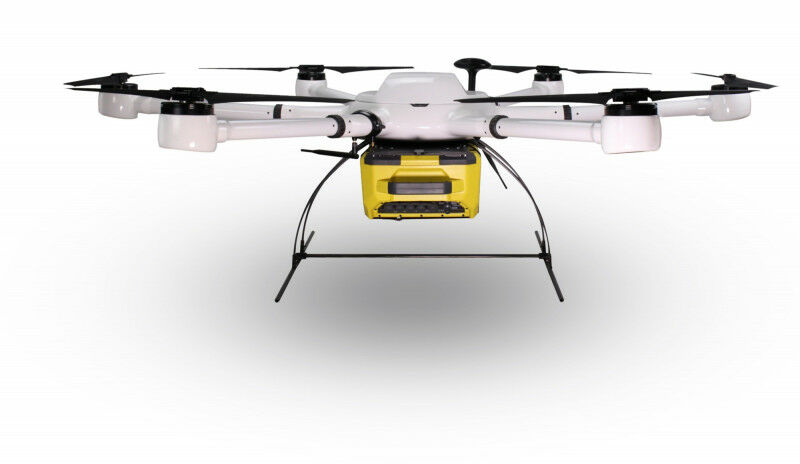
The Institute for Sanitary Engineering, Water Quality and Solid Waste Management (ISWA) at the University of Stuttgart is developing a new system for the detection and modeling of [Picture: exabotix]
The Institute for Sanitary Engineering, Water Quality and Solid Waste Management (ISWA) at the University of Stuttgart is developing a new system for the detection and modeling of [ Picture: exabotix] Landfills emit greenhouse gases from their surfaces such as methane. A new remote sensing method from the University of Stuttgart now makes it possible to record the concentration of emissions more comprehensively and model their propagation more precisely. The technology consists of a heavy-duty drone and an infrared measuring method known as Fourier-transform infrared spectroscopy (FTIR). It can be used for a variety of climate-relevant gases and also in other areas of application, for example in biogas and composting plants, at livestock farms, and even for surveying reservoirs. Climate-relevant gases such as methane, nitrous oxide, and carbon dioxide are released into the environment in a variety of processes and from a wide range of sources, for example through landfills or biogas plants. In order to be able to carry out climate protection measures in a targeted and effective manner, the levels of pollutants have so far been recorded within the scope of selective measurements on-site at the plant or along the measuring sections on the lee side of the plant, and extrapolated to the total emissions. However, such measurements are random and therefore inaccurate.
TO READ THIS ARTICLE, CREATE YOUR ACCOUNT
And extend your reading, free of charge and with no commitment.