 © Vincent Jassey, Laboratoire écologie fonctionnelle et environnement (CNRS/INP Toulouse/Université Toulouse III - Paul Sabatier)
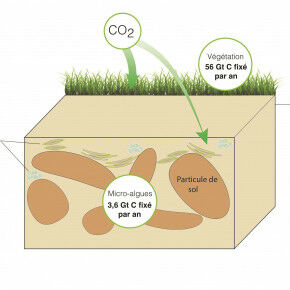
© Vincent Jassey, Laboratoire écologie fonctionnelle et environnement (CNRS/INP Toulouse/Université Toulouse III - Paul Sabatier) - There are roughly 5 million microscopic algae, on average, in each gram of topsoil, according to a study published in The New Phytologist on and involving scientists from the Laboratoire Écologie Fonctionnelle et Environnement (CNRS / INP Toulouse / Université Toulouse III-Paul Sabatier), the Department of Forest Ecology and Management of the Swedish University of Agricultural Sciences, the Laboratory of Nematology of Wageningen University, the Department of Terrestrial Ecology of the Netherlands Institute of Ecology, the University of Applied Sciences of Western Switzerland, the Climate Change Ecology Research Unit at Adam Mickiewicz University, and the Real Jardín Botánico of Madrid. Like plants, they sequester atmospheric CO
2, thereby adding to the soil carbon pool. In order to better understand the global distribution of these terrestrial algae and predict their annual productivity using a machine learning model, the team of researchers collated data from the literature on these microorganisms. They found that soil algae capture approximately 3.6 gigatonnes of carbon annually, equivalent to 30% of CO
2 emissions due to human activity. These results alter basic assumptions on the role played by microorganisms in the soil, showing that microbial photosynthesis is a major component of not only aquatic ecosystems but also most terrestrial ones, and they underscore the critical role of microalgae in the global carbon cycle.
TO READ THIS ARTICLE, CREATE YOUR ACCOUNT
And extend your reading, free of charge and with no commitment.
Your Benefits
- Access to all content
- Receive newsmails for news and jobs
- Post ads