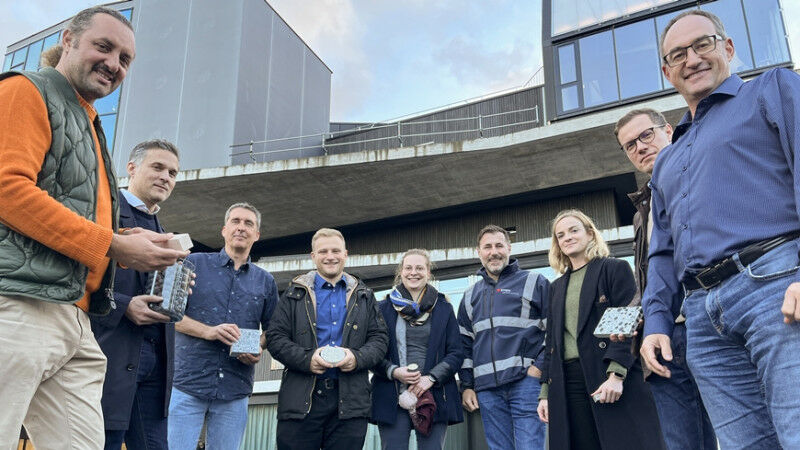
The architects from OOS cooperate with researchers to align new CO2-negative innovations from the Empa laboratories with the requirements of the construction sector. Bild: Empa
The architects from OOS cooperate with researchers to align new CO2-negative innovations from the Empa laboratories with the requirements of the construction sector. Bild: Empa Are buildings that affect our climate in a positive way soon going to be a reality? In order to achieve the ambitious net zero target by 2050, we as a society need to rethink the standards and procedures we are living by. One of the most impactful sectors is the construction industry. Through the use of advanced technologies, buildings could soon serve as carbon sinks and thus help to ensure that the CO2 concentration in the atmosphere no longer increases, or at best even decreases. A set of innovations from the Empa laboratories that are strongly CO2-reduced and even CO2-negative, are therefore going to be installed and tested in a real environment - inside a new unit at NEST, the innovation building of Empa and Eawag. In Switzerland, the construction sector is responsible for approximately 28% of total CO2 emissions, which gives it a key role in the ambitious goal of emitting no more greenhouse gases into the atmosphere by 2050. In addition to low-emission construction and operation of buildings, there is another promising solution: CO2 from the atmosphere can be bound in building materials and thus stored in buildings in the long term.
TO READ THIS ARTICLE, CREATE YOUR ACCOUNT
And extend your reading, free of charge and with no commitment.