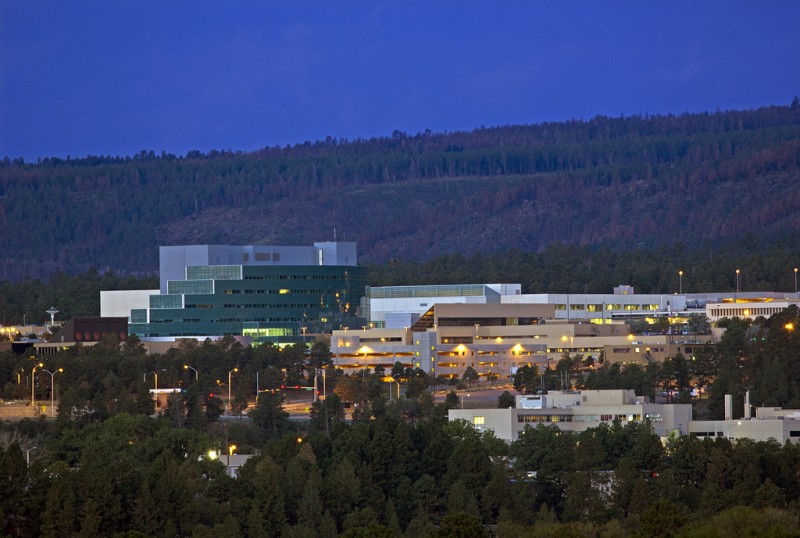
Los Alamos National Laboratory sits on top of a once-remote mesa in northern New Mexico with the Jemez mountains as a backdrop to research and innovation covering multi-disciplines from bioscience, sustainable energy sources, to plasma physics and new materials.
LANL and EMC will enhance, design, build, test, and deploy new cutting-edge technologies to meet some of the most difficult information technology challenges. Five-year agreement for technology development includes high performance computing, data storage, cyber security, cloud computing, analytics, materials science and data sharing, and mobility LOS ALAMOS, New Mexico, December 21, 2011—Los Alamos National Laboratory today announced the signing of a new Umbrella CRADA (Cooperative Research and Development Agreement) with EMC Corporation. Together, LANL and EMC will enhance, design, build, test, and deploy new cutting-edge technologies in an effort to meet some of the nation's most difficult information technology challenges. The CRADA involves six general categories of technology development in which LANL and EMC will collaborate over the next five years, including high-performance computing (HPC), data storage, cyber security, data sharing and mobility, cloud computing, large-scale analytics, and materials science. This first Project Task Statement (PTS) under the Umbrella CRADA is focused on support for the U.S. Department of Energy's Exascale Initiative and other data intensive programs. The LANL and EMC collaboration for the Exascale initiative is aimed at boosting high-performance computing levels to the exaflops—a thousand-times faster than current petascale capabilities. The project involves design and development of an open-source, extremely scalable data-management middleware library called the Parallel Log Structured File System (PLFS), which will be used on a range of computing platforms from small clusters to the largest supercomputers in the world.
TO READ THIS ARTICLE, CREATE YOUR ACCOUNT
And extend your reading, free of charge and with no commitment.