Combining antennas with solar panels
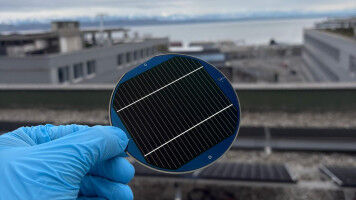
Researchers at EPFL have managed to combine antennas and solar cells to work together with unprecedented efficiency in a near future. This is a first step towards more compact and more lightweight satellites. The technology could also be deployed in the autonomous antenna systems used in the aftermath of natural disasters. Traditionally, telecommunication antennas and solar cells have never really worked well together, as they have to function independently of each other in order to avoid interference. This has an impact on the weight and size of satellites - the surface area has to be large enough for both antenna systems, which emit and receive data, and solar panels, which supply the electricity. For his master project, Philippe Dreyer, who is part of Julien Perruisseau-Carrier Group, has been working on ways to combine solar cells and antennas. In collaboration with the Transparent Conductive Oxides group (TCOs) which is part of the Photovoltaics and Thin Film Electronics Laboratory (PV-Lab), he has developed a mixed surface that allows both the antenna and the photovoltaic cell to perform extremely efficiently.