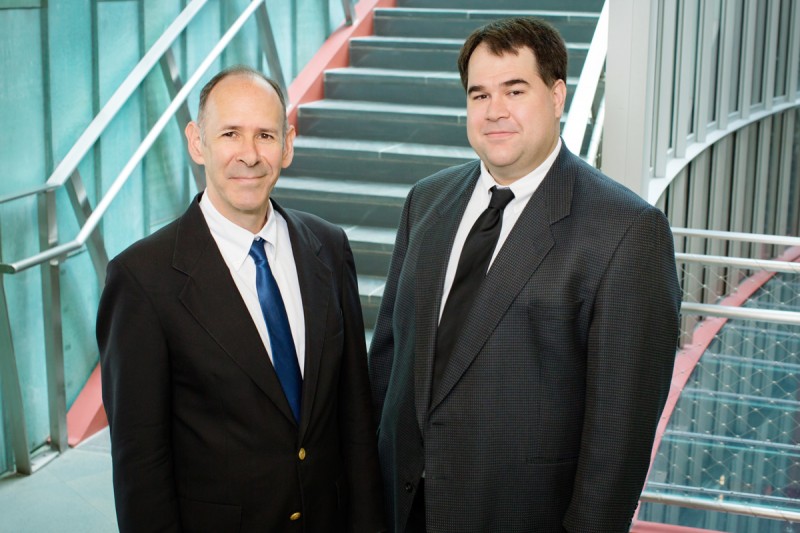
Researchers Sheldon H. Jacobson, left, and Douglass M. King developed a new computer algorithm that may offer state legislators a new solution to the contentious task of congressional redistricting. L. Brian Stauffer
CHAMPAIGN, Ill. — Concerns that the process of U.S. congressional redistricting may be politically biased have fueled many debates, but a team of University of Illinois computer scientists and engineers has developed a new computer algorithm that may make the task easier for state legislatures and fairer for their constituents. "United States congressional district maps are redrawn every 10 years in response to national census data, and this process empowers every state legislature to decide how they will carve up each of their congressional districts," said Illinois professor of computer science Sheldon H. Jacobson. "One of the problems is that this can lead to oddly shaped and dispersed districts that favor one political agenda over another." The researchers' study, performed in collaboration with Douglas M. King , a lecturer of industrial and enterprise systems engineering , proposes a new, geographically based and data-driven algorithm that allows a user to specify the goal that guides the creation of the districts, then creates the districts computationally while enforcing other requirements, such as each district being a contiguous area. Their algorithm speeds up computations by gleaning insight from the geography of the state. "As data scientists who study and analyze algorithms, we bring a nonpartisan approach to this problem," Jacobson said. "It's just data.
TO READ THIS ARTICLE, CREATE YOUR ACCOUNT
And extend your reading, free of charge and with no commitment.