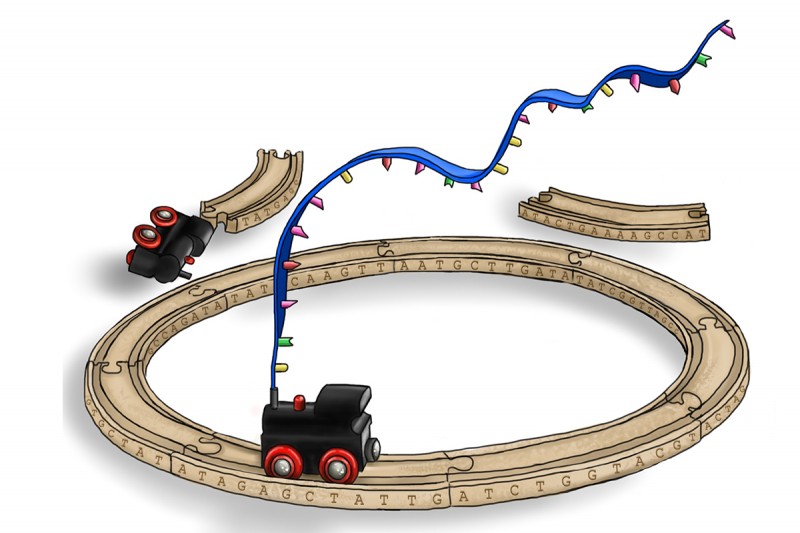
 Transcription from ultra-short deleted DNA segments is made possible by their concatenation and circularisation. Excised DNA segments are represented by pieces of train track. The RNA polymerase, represented by the train engine, can only proceed when segments are joined together.
Media releases, information for representatives of the media Media Relations (E) A species of unicellular ciliate has found a special trick to make use of the cellular machinery in seemingly impossible ways. Researchers of the NCCR «RNA & Disease - The Role of RNA Biology in Disease Mechanisms» of the University of Bern have for the first time described a mechanism in detail how so called «junk»-DNA is transcribed before being degraded - and this mechanism is remarkably clever. It sounds a bit like the winning proposal in a design contest: How can small pieces of information be read when they are too short to fit into the reading apparatus' Stitch them together into a longer string and close the string to produce a handy loop that can even be read off repeatedly. That's how a little organism called Paramecium tetraurelia , a species of unicellular ciliate, organises the transcription of small excised DNA segments into RNAs, which have a regulatory function. But the story actually goes the other way round: When Mariusz Nowacki from the Institute of Cell Biology of the University of Bern found small RNAs with a regulatory function in the elimination of segments out of the Paramecium DNA, he and his team started to investigate the molecular mechanisms - where do these RNAs come from, and what exactly is their role? They soon found out that there seems to be a sort of a feedback loop in the deletion of DNA segments. These, previously thought to be useless pieces of DNA (also called 'junk DNA'), are cut out of the genome and then degraded by the cell machinery.
TO READ THIS ARTICLE, CREATE YOUR ACCOUNT
And extend your reading, free of charge and with no commitment.
Your Benefits
- Access to all content
- Receive newsmails for news and jobs
- Post ads