Many characteristics of workwear are conducive to a textile circular economy: it is relatively uniform, traceable and comes from a single source. An Innosuisse-sponsored study by Lucerne University of Applied Sciences and Arts shows where the potential for success lies and where the sticking points are on the path to a circular economy.
When it comes to textiles, there can be no talk of a circular economy, either in Switzerland or worldwide. "It would be desirable to process fabrics for reuse as a product or as a new raw material, but there are still many obstacles in the way," says Tina Tomovic, HSLU expert in textile sustainability. The question of how to turn the fibers of old fabric into new fabric is just one of the problems. In a pilot test, the team from Lucerne University of Applied Sciences and Arts has now shown that it is basically possible to mechanically recycle used workwear and spin it back into new fabric. The new fabrics contained up to 39 percent recycled material, which is significantly more than is usually offered on the market in workwear. However, the quality still needs to be improved before the new materials can actually be used, as fabrics for workwear need to be very hard-wearing and durable.
Workwear offers good recycling conditions
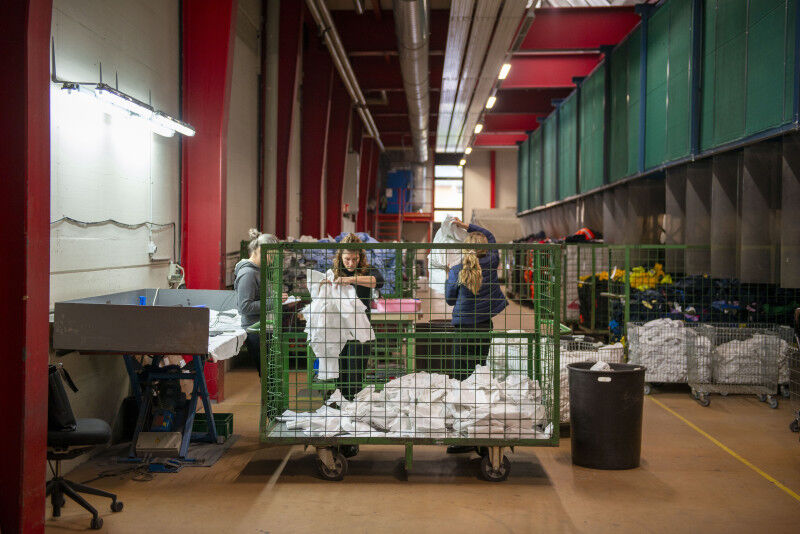
One of the obstacles to textile cycles is the different, often undeclared materials and the different colors that come together in the textile collection, says Tina Tomovic. Work clothing - for example in hospitals or factories - has good prerequisites here: There is a large amount of clothing with the same fiber composition. And that’s not all; the clothing is often washed centrally. As a result, there is more control throughout the process chain over which materials are used or how often an item has been worn, washed and mended. In addition, workwear is now being chipped in order to overcome the logistical challenges of washing processes. This data basis holds great potential for achieving the goals of the circular economy. This is why textile experts from Lucerne University of Applied Sciences and Arts have joined forces with stakeholders along the value chain to launch the "Circular Workwear" project, which is funded by Innosuisse.
The more people involved, the more complex the recycling
Many players have to work together to create a cycle in the first place. The university alone needed expertise in design, IT and technology. It was therefore clear that the project also required many partnerships: Hüsler Berufskleider AG developed circularly optimized garments for nursing staff, CWS provided materials and supported the project from the perspective of industrial laundries, Texaid collected and sorted the discarded textiles and Datamars designed models for sharing data within the value chain. Customers such as Coop and a care home were also involved in certain areas, as was the expertise of machine manufacturer Säntis Textiles and the industry association Sustainable Textiles Switzerland 2030.
Incineration plant remains the biggest competition for the textile cycle
What the companies involved in the project will take away for the next steps towards a circular economy are recommendations that they can implement in their own operations, as well as an assessment tool for the recyclability of workwear. And an important insight: the entire industry must work together to ensure that product data and textile raw materials can be managed in a circular way in the future. Better networking, circular design strategies and the tracking of material flows and data are therefore at the top of the list of priorities. And also important: companies now have a set of arguments that can be used to persuade customers to invest in sustainable materials at a higher price. Because this much is clear: "As long as recycled fibers are more expensive than virgin fibers, the incineration plant is the biggest competition for a textile cycle, even if the industry itself is fully committed," says Tina Tomovic.
Circular economy at the Lucerne University of Applied Sciences and Arts
How can waste, from building rubble to clothing, be reused in a high-quality way? How do we transform processes into cycles? And what perspectives do politics and science offer in practice? At Lucerne University of Applied Sciences and Arts, various departments often work together on the technical and economic prerequisites that make a circular economy possible in the first place. Whether it’s concrete, textile fibers, plastic or metal - it’s all about complex processes. In order to develop these, the expertise of HSLU researchers and practitioners is needed in equal measure.