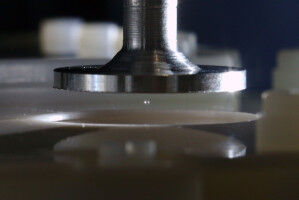
Olivier Fontaine and his colleagues examine the challenges we face in electrifying the entire vehicle fleet.
Are we really ready to make a complete shift to electric vehicles in the next few decades? While the social and geopolitical challenges associated with battery materials are well known, little attention has been paid to electrolytes, despite the fact that both the European Parliament and several countries are aiming for 100% of new vehicles sold to be electric in just 10 years’ time.
Olivier Fontaine, a professor in the Department of Chemistry at the Université de Montréal, and a number of his colleagues have immersed themselves in the subject. "We asked ourselves the question: with today’s technology, is this a political announcement, or can the production chain keep up? Our conclusion is rather alarming: we don’t really have a viable solution", he asserts.
A battery has three compartments: a positive electrode, a negative electrode and, in the middle, the electrolyte. "This is what separates the two electrodes, allowing the ions to circulate and keep the battery running without exploding," explains Olivier Fontaine.
Several research teams and companies have been working to find greener, more efficient or more local materials for manufacturing electrodes. But when it comes to the electrolyte, almost nothing has been done. "It’s often considered easy to produce because it’s a salt mixed with a solvent. Companies buy liquid electrolytes from China, but it’s a bit of a black box, with almost no questions asked," he says.
But to manufacture these electrolytes, we’ll need mining resources: phosphate, lithium and fluoride. A lot of resources. "This will create other geopolitical problems, because these resources are not abundant in all countries," points out Olivier Fontaine.
Scenarios
To flesh out their thinking, the team considered three scenarios for estimating the electrolyte (and therefore mineral) requirements of each country: the first simulates complete electrification of the vehicle fleet, while the other two are based on predictions of electric vehicle adoption rates. Olivier Fontaine and his colleagues then examined the geographical distribution of these critical minerals.
With the planned scale-up, up to 1.5 million tonnes of electrolytes would be required. "To imagine that we’ll be able to make an energy transition with 100% electric cars is to go straight into the wall, at least with current technology", sums up the researcher.
To be efficient, batteries are powered by lithium hexafluorophosphate, a fluorinated salt based on lithium and phosphate. On the one hand, phosphate is used in a host of fields, including agriculture as a fertilizer. "The moment you use phosphates to make a car run, you’re not using phosphates to make fertilizers or other types of technology," he notes. Not to mention the fact that almost 50% of phosphate reserves are located in just one country, Morocco, which heralds tensions in the supply chain. "We want energy independence so that we no longer have a geopolitical problem with oil, but this creates others," he adds.
Major changes to consider
The authors also looked at alternatives, including recycling, greener electrolytes and new materials. For example, some components could be produced from biomass. But as with biofuels, these so-called green solutions have the great disadvantage of monopolizing agricultural land to power vehicles rather than feed people. What’s more, these biomass-based pathways produce electrolytes containing water. Lithium batteries work very well today because the electrolyte is non-aqueous. If you use an aqueous electrolyte, battery voltage is greatly reduced. Slightly greener solutions contain water by default, and that’s a drag on innovation," he notes.
Recycling the electrolyte in end-of-life batteries is another avenue to consider, although for the moment it too is paved with difficulties. Most recycling processes currently focus only on electrode materials, completely ignoring the electrolyte - whose variable composition makes it difficult to recover.
The scientific community will therefore have to speed up the search for sustainable alternatives to electrolytes, which is what the researcher and his colleagues are working on. Even so, "it’s unrealistic to think that in 10 years’ time we’ll be able to find an alternative to electrolytes", he believes. Because these new materials have to be economical, green, abundant, efficient and stable, and their development will take several years. "Faced with elements that are multidimensional, artificial intelligence could help answer these questions", he hopes.
But society will also need to rethink its relationship with the car, suggests Olivier Fontaine. "We see the electric car as a continuation of the internal combustion car, but there may be another model to imagine. Greener electrolytes are less efficient, but if we change our car consumption habits, they could have a role to play in the transition," he concludes.
About the study
The article "The urgent electrolyte sustainability challenges for electric vehicle batteries", by Olivier Fontaine and colleagues, was published in Nature Communications.