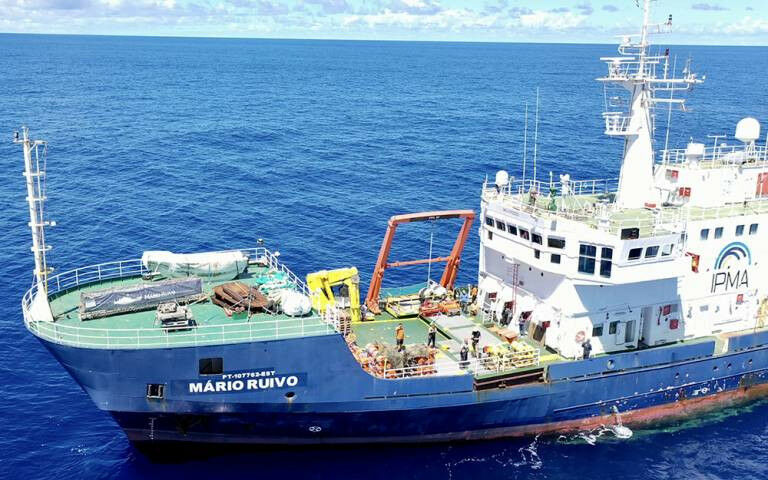
Picture taken by drone of the research ship used to retrieve the seismometers
Picture taken by drone of the research ship used to retrieve the seismometers - Explosions from a sinking ship are among the unexpected sounds detected by 50 highly sensitive seismometers placed on the floor of the Atlantic Ocean as part of an international collaboration led by UCL researcher Professor Ana Ferreira. The seismometers, which have now been collected after spending a year at the bottom of the ocean, record the Earth's ground motions on the sea floor and thus capture the Earth's "pulse". Many of these recordings capture seismic waves that travelled deep and long inside the Earth following distant earthquakes, as well as from lots of small local ones, which will be used to build images of the Earth's interior down to ~2,800 km depth. The techniques used are similar to those employed by medical doctors to build CAT scans of the human body. The aim of the project, called UPFLOW (UPward mantle FLOW from novel seismic observations), is to better understand massive "upwellings" of material pushing up from Earth's mantle, which are poorly understood and ultimately cause volcanic eruptions and can lead to earthquakes. But as well as ground motions due to earthquakes, the seismometers also pick up vibrations caused by a wide range of phenomena - including passing ships, magma intrusions in nearby volcanoes causing small local earthquakes, and singing whales. Some signals in the data were linked to a massive volcanic eruption on the other side of the planet.
TO READ THIS ARTICLE, CREATE YOUR ACCOUNT
And extend your reading, free of charge and with no commitment.