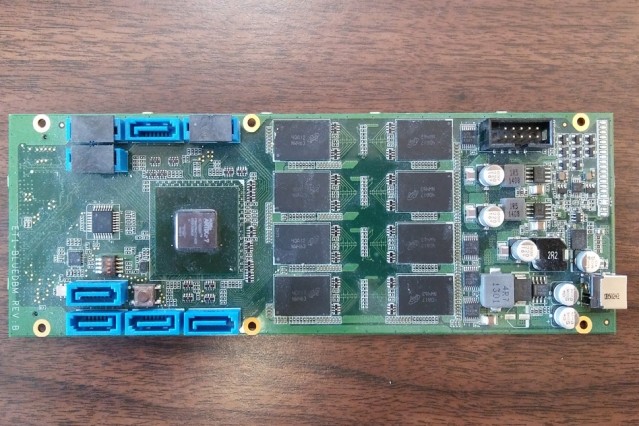
Researchers from MIT’s Computer Science and Artificial Intelligence Laboratory (CSAIL) have designed a device that helps cheap flash storage process massive graphs on a personal computer. The device (pictured here) consists of a flash chip array (eight black chips) and computation "accelerator" (square piece directly to the left of the array). A novel algorithm sorts all access requests for graph data into a sequential order that flash can access quickly and easily, while merging some requests to reduce the overhead of sorting.
In data-science parlance, graphs are structures of nodes and connecting lines that are used to map scores of complex data relationships. Analyzing graphs is useful for a broad range of applications, such as ranking webpages, analyzing social networks for political insights, or plotting neuron structures in the brain. Consisting of billions of nodes and lines, however, large graphs can reach terabytes in size. The graph data are typically processed in expensive dynamic random access memory (DRAM) across multiple power-hungry servers. Researchers from MIT's Computer Science and Artificial Intelligence Laboratory (CSAIL) have now designed a device that uses cheap flash storage - the type used in smartphones - to process massive graphs using only a single personal computer. Flash storage is typically far slower than DRAM at processing graph data. But the researchers developed a device consisting of a flash chip array and computation "accelerator," that helps flash achieves DRAM-like performance.
TO READ THIS ARTICLE, CREATE YOUR ACCOUNT
And extend your reading, free of charge and with no commitment.