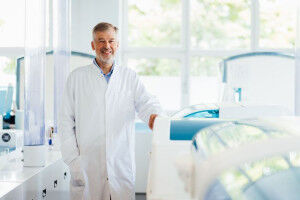
Patient Tre Porfirio visits Tuesday with the doctors who helped save the airman’s life. From left, Camillo Ricordi, M.D., of the Miller School, and Craig Shriver, M.D., and Rahul Jindal, M.D., of Walter Reed, teamed up to perform the surgery.
December 16, 2009 — Miami — A 21-year-old Georgia airman who was gravely wounded in Afghanistan and faced a future as a severe diabetic may live a normal life after the Miller School's Diabetes Research Institute helped doctors at Walter Reed Army Medical Center perform an unprecedented transplant of the serviceman's own insulin-producing cells. The Thanksgiving Day transplant was performed by Walter Reed surgeons in Washington, D.C., under the telemedicine-assisted guidance of DRI Director Camillo Ricordi, M.D., the professor of surgery who invented the machine and method for isolating large numbers of islets and transplanting them into the liver to reverse diabetes. Just 15 hours earlier, Ricordi and his four-member DRI team began an all-night race against the clock to isolate U.S. Air Force Senior Airman Tre Porfirio's islets from his damaged pancreas, which had been partially removed after he was shot three times in Afghanistan five days before Thanksgiving. Completely removed at Walter Reed, the organ was rushed to Miami, arriving late Wednesday as most people were readying for bed, and the long holiday weekend. By Thanksgiving afternoon, Walter Reed doctors had more than 220,000 of Porfirio's re-purified islets suspended in a Ricordi infusion bag and, with Ricordi's remote guidance, began injecting them into the Air Force enlistee's liver via his portal vein. Today, the transplanted islet cells are producing insulin in the normal range. 'This was the first successful post-traumatic autologous pancreatic islet transplant performed in an emergency procedure,'?
TO READ THIS ARTICLE, CREATE YOUR ACCOUNT
And extend your reading, free of charge and with no commitment.