Whether we are using e-banking, WhatsApp or saving files in the cloud, our data is encrypted to protect it from prying eyes. Esther Hänggi and her team from the Applied Cyber Security Research Lab at Lucerne University of Applied Sciences and Arts are researching how quantum physics can help us do this.
Esther Hänggi, you keep reading in the media that quantum computers will be able to crack today’s encryption techniques immediately in the future. Is that true?
Yes, quantum computers will be able to break most of the cryptography used today. So if information is to remain secret for decades - such as state secrets or sensitive company data - we need to develop and use encryption methods now that are also secure against future technologies.
Quantum physics provides a solution. How can it help us to make digital communication more secure?
One important approach is the so-called quantum key distribution. This method uses the principles of quantum mechanics to exchange cryptographic keys between communication partners.
What does that mean exactly?
With traditional encryption methods - for example in e-banking - two parties agree on a secret key. The security is based on the fact that it would take too long for an attacker who wants to intercept the communication to find out the key. In quantum key distribution, particles of light - known as photons - are used to generate the key. If an attacker tries to eavesdrop on these light particles, they change their state at that moment. As a result, the eavesdropping attempt is detected and the key is discarded.
Where is this technology already being used?
Quantum key distribution requires, firstly, special hardware to send and measure light particles and, secondly, a direct fiber optic connection, but quantum key distribution does not require a quantum computer. These devices can already be bought and used today. We also have a quantum key distribution device at HSLU. Because quantum key distribution requires a permanent fiber optic connection, it is predestined for connections between data centers, in energy networks or for the core network of telecommunications. Many countries are currently building entire quantum key distribution networks: for example Singapore, South Korea, China, the UK and most EU countries. In the EU, the individual networks are also to be connected to form a large network with the help of satellites.
At the Applied Cyber Security Research Lab, you are also researching how quantum cryptography can be used in practice. What are the exciting topics you are currently working on?
We are researching both highly application-related issues and innovative ideas for the future. We also work closely with companies to investigate how quantum key distribution devices or quantum random number generators can be integrated into their IT systems. It is particularly useful that we have these devices at HSLU and can use them for our experiments. We are also developing software that makes quantum key distribution even faster and therefore more user-friendly. Finally, we are also asking ourselves what future applications there are for quantum technologies.
They are taking part in this year’s Engineers’ Day. At Lucerne railroad station, visitors will have the opportunity to guess a number generated by a quantum random number generator. What role do random numbers play in cyber security?
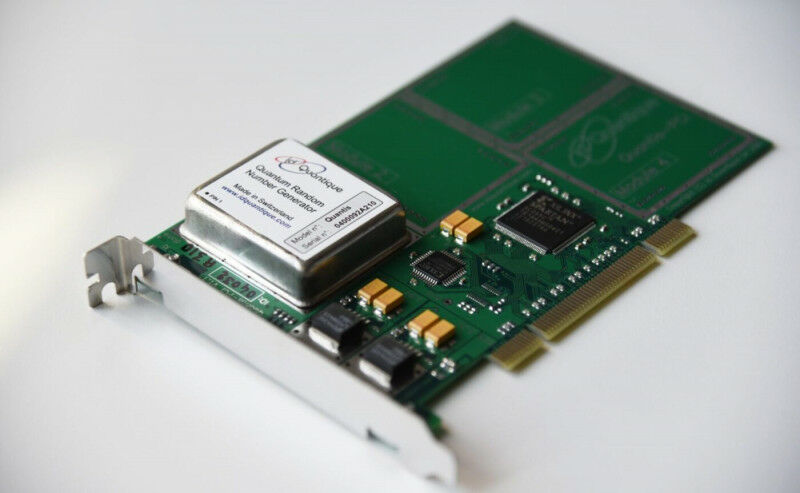
The quantum random number generator generates real random numbers. A computer cannot generate true random numbers and therefore requires a physical source. True random numbers are central to cyber security because every key must be random. A password that is easy to guess is not a good password.
Can you give further examples of applications where quantum random numbers are used?
In services for electronic certificates or electronic online signatures, or in online competitions and lottery draws. Samsung has even developed and launched a smartphone with a built-in quantum random number generator chip.
What role does artificial intelligence actually play in quantum cryptography?
None! Security is based on the laws of quantum physics. It doesn’t matter whether AI is used or not.
2025 - The UN Year of Quantum
The United Nations has declared 2025 the International Year of Quantum Science and Technology (IYQ). The 100th anniversary of quantum mechanics is to be used as an opportunity to raise public awareness of the importance and influence of quantum science and applications on all aspects of life. Further information is available at quantum2025.org.
Interview: Andreas Bättig
Picture: Franca Pedrazzetti
Published: February 13, 2025