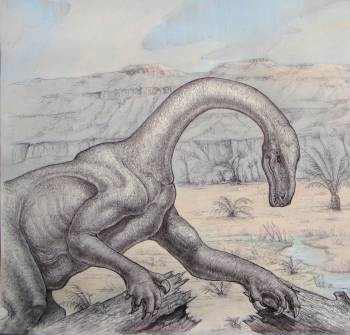
Artist’s reconstruction of Sarahsaurus . Illustration: John Maisano
October 5, 2010 AUSTIN, Texas — A new species of dinosaur discovered in Arizona suggests dinosaurs did not spread throughout the world by overpowering other species, but by taking advantage of a natural catastrophe that wiped out their competitors. Tim Rowe , professor of paleontology at The University of Texas at Austin's Jackson School of Geosciences , led the effort to describe the new dinosaur along with co-authors Hans-Dieter Sues, curator of vertebrate paleontology at the National Museum of Natural History in Washington, D.C., and Robert R. Reisz, professor and chair of biology at the University of Toronto. The description appears in the online edition of the journal Proceedings of the Royal Society B on Oct. Sarahsaurus , which lived about 190 million years ago during the Early Jurassic Period, was 14 feet long and weighed about 250 pounds. Sarahsaurus was a sauropodomorph, a small but closely related ancestor to sauropods, the largest land animals in history. Conventional wisdom says that soon after dinosaurs originated in what is now South America, they rapidly spread out to conquer every corner of the world, so smart and powerful they overwhelmed all the animals in their path. Sarahsaurus challenges that view.
TO READ THIS ARTICLE, CREATE YOUR ACCOUNT
And extend your reading, free of charge and with no commitment.