?The way we measure street lighting is still very primitive,? says Sumeet Kumar PhD ?14. Kumar and his team came up with the idea of replacing manual inspections with a set of cameras and sensors mounted on top of a vehicle, in much the same way that Google uses vehicle-mounted camera systems to generate its street views.
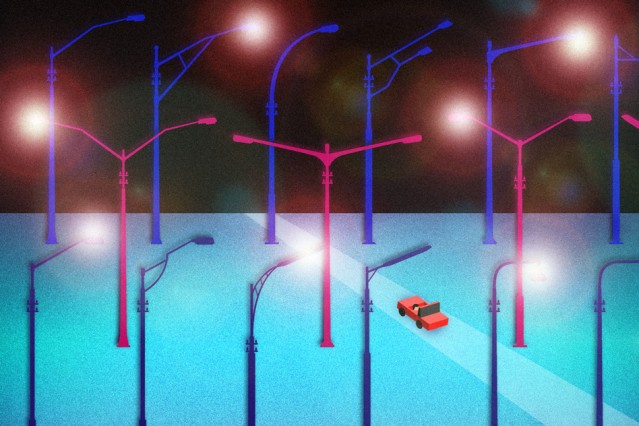
Is there a streetlight burned out on your block? Unless you or your neighbors phone the right city department, there's a good chance nobody knows about it. Most cities don't have any comprehensive listing or map of where their lights are located, what kind they are, what their expected operational lifetimes are, how high they are, or when they were last replaced. And the prevailing system for answering those questions is to send inspectors out, clipboard in hand, to examine the city's streets one by one - a slow and expensive process. The result of this inefficiency can be that burned-out lights are not replaced promptly, or that perfectly good lights are replaced unnecessarily as a preventive measure, or that crews are sent out with a 30-foot lift truck to replace a light that turns out to be on a 40-foot pole. There must be a better way, a team of researchers at MIT's Department of Mechanical Engineering thought. And after several iterations of software and hardware developed in the lab and field-tested on city streets, the researchers have found that better way, which they reported in a paper in the journal IEEE Sensors . The team includes Sumeet Kumar PhD '14; Sanjay Sarma, the Fred Fort Flowers and Daniel Fort Flowers Professor in Mechanical Engineering and vice president for open learning; and three others.
TO READ THIS ARTICLE, CREATE YOUR ACCOUNT
And extend your reading, free of charge and with no commitment.