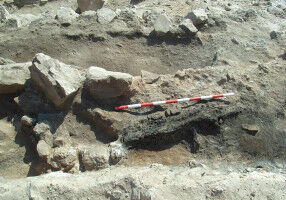
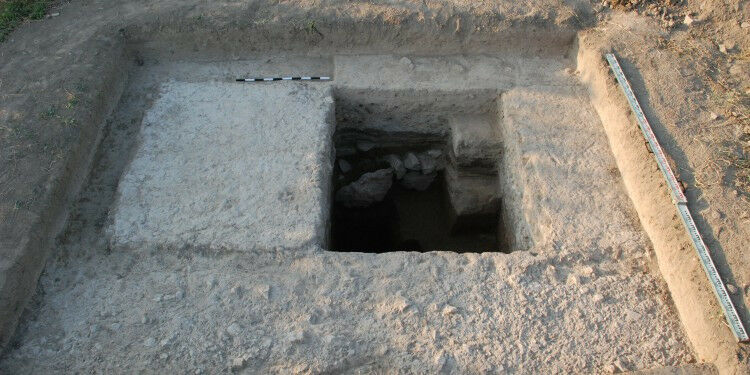
 The excavation trench shows a pillar of the unfinished aqueduct.
The excavation trench shows a pillar of the unfinished aqueduct. Artaxata project Archaeologists from the University of Münster and the National Academy of Sciences of the Republic of Armenia have discovered remains of a Roman arched aqueduct during excavation work on the Hellenistic royal city of Artashat-Artaxata in ancient Armenia. It is the easternmost arched aqueduct in the Roman Empire. Excavation work took place back in 2019, and an evaluation of the find has now been published in the "Archäologischer Anzeiger" journal. "The monumental foundations are evidence of an unfinished aqueduct bridge built by the Roman army between 114 and 117 CE," explains author Prof. Achim Lichtenberger from the Institute of Classical Archaeology and Christian Archaeology at the University of Münster. "At that time, Artaxata was destined to become the capital of a Roman province in Armenia." It was during this time that the Roman Empire reached its greatest extent - if only for a short while - because it was under Trajan, who was Emperor of Rome from 98 to 117 CE - that the Romans attempted to incorporate the province of Armenia into the Roman Empire. "The planned, and partially completed, construction of the aqueduct in Artaxata shows just how much effort was made, in a very short space of time, to integrate the infrastructure of the capital of the province into the Empire," says co-author Torben Schreiber from the Institute of Classical Archaeology and Christian Archaeology at the University of Münster.
TO READ THIS ARTICLE, CREATE YOUR ACCOUNT
And extend your reading, free of charge and with no commitment.
Your Benefits
- Access to all content
- Receive newsmails for news and jobs
- Post ads