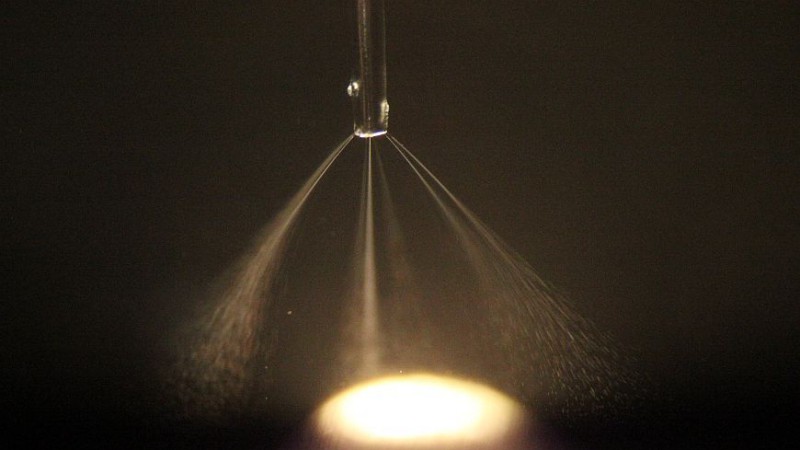
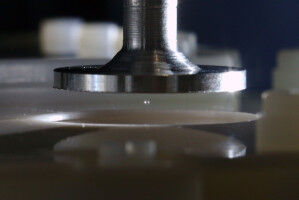
For the development of artificial muscles, the Empa scientists experimented with alternating current electrospraying
Researchers from Empa and the University of Basel have developed a new method of electrospraying which enables artificial muscles to be fabricated from nanometer-thin silicone layers. Since muscles of this type can operate at a low voltage, there are potential future medical applications in the treatment of incontinence. Elastomers - also referred to as electroactive polymers (EAP) - transform electrical energy into mechanical energy and have a wide variety of applications, from powering windscreen wipers and generating sound to operating camera lenses. As an example of this, Optotune, a spin-off of ETH Zürich and Empa, have already launched infinitely focusable lenses of this type on the market. The principle is always the same: two electrodes are applied to the synthetic material, creating an electrical field. When voltage is applied, the material expands. When current no longer flows, the material contracts again.
TO READ THIS ARTICLE, CREATE YOUR ACCOUNT
And extend your reading, free of charge and with no commitment.