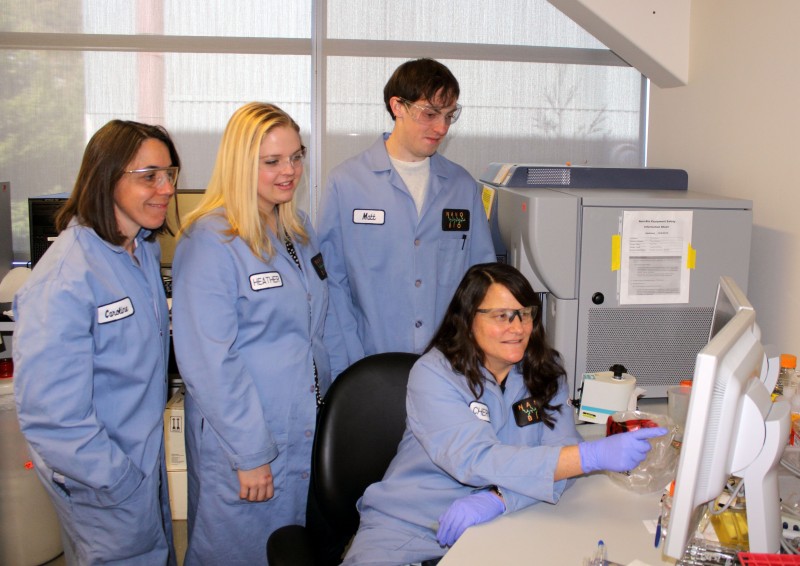
Authors of the recent publication in the Biological Nanostructures Laboratory. From left to right: Caroline Ajo-Franklin, Heather Jensen, Matt Hepler, Cheryl Goldbeck
Just like electronics, living cells use electrons for energy and information transfer. Despite electrons being a common "language" of the living and electronic worlds, living cells cannot speak to our largely technological realm. Cell membranes are largely to blame for this inability to plug cells into our computers: they form a greasy barrier that tightly controls charge balance in a cell. Thus, giving a cell the ability to communicate directly with an electrode would lead to enormous opportunities in the development of new energy conversion techniques, fuel production, biological reporters, or new forms of bioelectronic systems. Previous studies performed by scientists and collaborators at Lawrence Berkeley National Laboratory's (Berkeley Lab) Molecular Foundry have made enormous headway toward cellular-electrode communication by using E. coli as a testbed for expressing an electron transfer pathway naturally occurring in a bacterial species called Shewanella oneidensis MR-1. The engineered E. coli was able to use the protein complex to reduce nanocrystalline iron oxide (Jensen, et al. PNAS .
TO READ THIS ARTICLE, CREATE YOUR ACCOUNT
And extend your reading, free of charge and with no commitment.