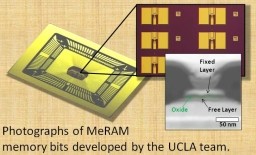
MeRAM bit
By using electric voltage instead of a flowing electric current, researchers from. UCLA's Henry Samueli School of Engineering and Applied Science have made major improvements to an ultra-fast, high-capacity class of computer memory known as magnetoresistive random access memory, or MRAM. The UCLA team's improved memory, which they call MeRAM for magnetoelectric random access memory, has great potential to be used in future memory chips for almost all electronic applications, including smart-phones, tablets, computers and microprocessors, as well as for data storage, like the solid-state disks used in computers and large data centers. MeRAM's key advantage over existing technologies is that it combines extraordinary low energy with very high density, high-speed reading and writing times, and non-volatility — the ability to retain data when no power is applied, similar to hard disk drives and flash memory sticks, but MeRAM is much faster. Currently, magnetic memory is based on a technology called spin-transfer torque (STT), which uses the magnetic property of electrons — referred to as spin — in addition to their charge. STT utilizes an electric current to move electrons to write data into the memory. Yet while STT is superior in many respects to competing memory technologies, its electric current-based write mechanism still requires a certain amount of power, which means that it generates heat when data is written into it.
TO READ THIS ARTICLE, CREATE YOUR ACCOUNT
And extend your reading, free of charge and with no commitment.