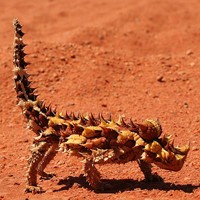
Thorny devil (Moloch horridus)
A new website that explains why humans have the same type of eye as an octopus, and how animals separated by millions of years have evolved in the same way, has been launched by a team of scientists at Cambridge University. The Map of Life (www.mapoflife.org) highlights hundreds of examples of 'evolutionary convergence' such as Australia's thorny devil lizard (pictured) and North America's desert horned lizard. Despite being separated by 150 million years of evolution, both lizards have evolved the same way of collecting drinking water through their skin. The new website also explains why the fiery colours of autumn leaves that adorn hundreds of different tree species are examples of convergent evolution, as well as exploring the similarities between ants that farm and sea cows that graze. The Map of Life project is coordinated by Professor of Evolutionary Palaeobiology Simon Conway Morris in the Department of Earth Sciences to provide an accessible website for the public, as well as for students and academics. Dr Chloe Cyrus-Kent, a member of the team behind the Map of Life, will be at this month's Cambridge Science Festival (www.cam.ac.uk/sciencefestival), the UK's largest free science festival, providing a chance to explore who's related to whom through convergent evolution, whether it be among gliding animals, desert plants or burrowing creatures. She said: "Convergent evolution occurs when unrelated organisms acquire similar adaptations to life in similar environments but from very different starting points.
TO READ THIS ARTICLE, CREATE YOUR ACCOUNT
And extend your reading, free of charge and with no commitment.