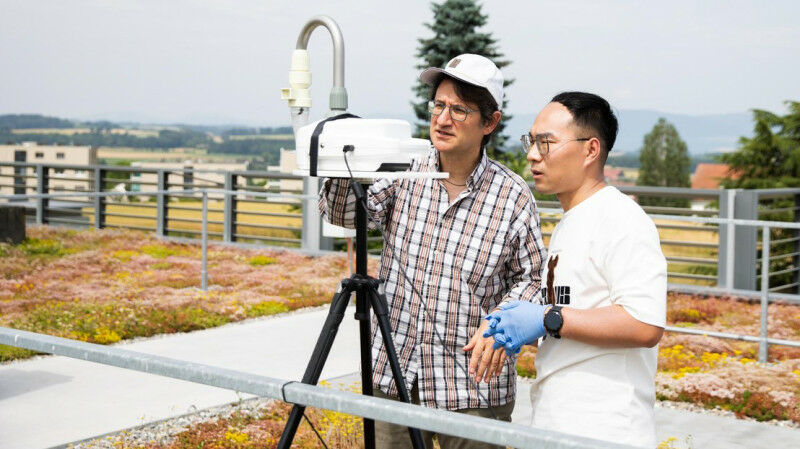
 Nenes and postdoc Kunfeng Gao on the roof of MeteoSwiss building in Payerne.
Nenes and postdoc Kunfeng Gao on the roof of MeteoSwiss building in Payerne. A. Goy/EPFL Since the start of this year, a suite of instruments has been hard at work detecting a broad spectrum of aerosols at the MeteoSwiss weather station in Payerne, in Vaud Canton. This pioneering project - a joint initiative between EPFL, the Swiss Federal Office of Meteorology Climatology and European partners - aims to improve pollen forecasting and to gain further insights into the critical impact that bioaerosols, smoke and dust have on cloud formation and climate. Hay-fever sufferers will be acutely familiar with the Swiss Federal Office of Meteorology Climatology (MeteoSwiss) pollen maps and their shades of red and yellow. These forecasts play a vital role in guiding public-health measures, especially after Switzerland experienced record-high pollen counts this spring. In an effort to develop more detailed and accurate forecasting capabilities, various new instruments were installed at the Payerne upper air station at the start of this year. This marks the first time such instruments have been deployed simultaneously.
TO READ THIS ARTICLE, CREATE YOUR ACCOUNT
And extend your reading, free of charge and with no commitment.
Your Benefits
- Access to all content
- Receive newsmails for news and jobs
- Post ads