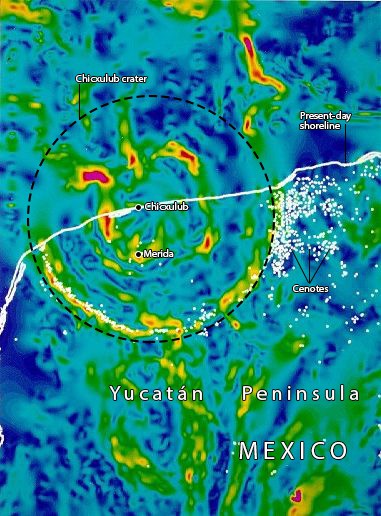
The Chicxulub crater has been filled in by sediments over the millions of years since impact. Using a gravity map, the crater’s topological features can be visualized. The red and yellow are gravity highs, and green and blue are gravity lows. The white dots indicate a network of sinkholes called "cenotes,"which were formed as a result of the impact. Image: NASA
AUSTIN, Texas - An international research team is formalizing plans to drill nearly 5,000 feet below the seabed to take core samples from the crater of the asteroid that wiped out the dinosaurs. The group met this week in Merida, Mexico, a city within the nearly 125-mile-wide impact site, to explain the research plans and put out a call for scientists to join the expedition planned for spring 2016. The roughly $10 million in funding for the expedition has been approved and scheduled by the European Consortium for Ocean Research Drilling (ECORD) - part of the International Ocean Discovery Program (IODP) - and the International Continental Scientific Drilling Program (ICDP). Dinosaurs and other reptiles ruled the planet for 135 million years. That all changed 65.5 million years ago when a 9-mile-wide asteroid slammed into the Earth, triggering a series of apocalyptic events that killed most large animals and plants, and wiped out the dinosaurs and large marine reptiles. The event set the stage for mammals - and eventually humans - to take over. Yet, we have few geologic samples of the now buried impact crater.
TO READ THIS ARTICLE, CREATE YOUR ACCOUNT
And extend your reading, free of charge and with no commitment.