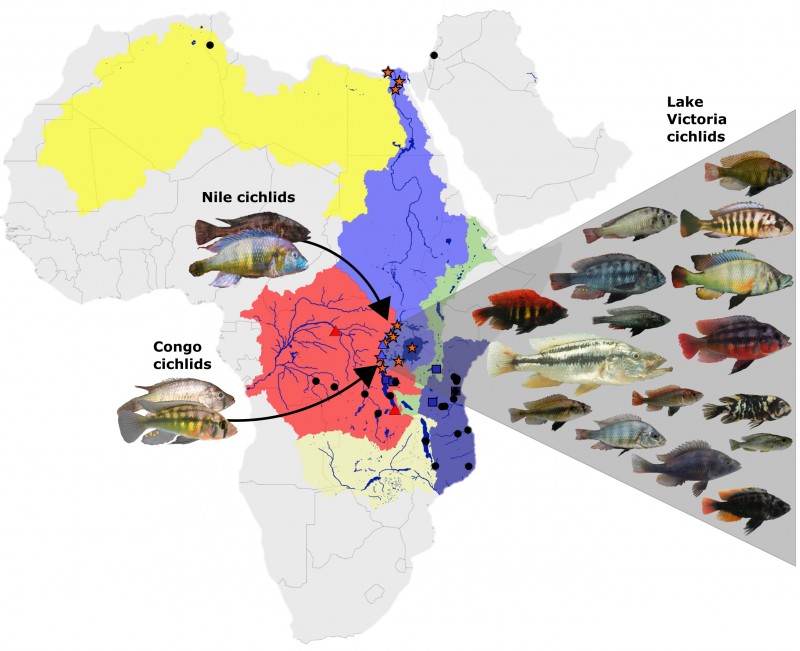
 Cichlids from the Upper Nile and the Congo river drainage systems were the ancestors of the roughly 700 diverse cichlid species endemic to the Lake Victoria region (some of which are pictured here) - including 500 in Lake Victoria alone.
No less than 500 new species of cichlids, brightly coloured perch-like fish, evolved in Lake Victoria (East Africa) over the past 15,000 years - a record in the animal and plant world. This evolutionary puzzle has now been solved by scientists from Eawag and the University of Bern. In a study published in 'Nature Communications', they demonstrate for the first time that this rapid evolution was facilitated by earlier hybridization between two distantly related cichlid species from the Upper Nile and Congo drainage systems. The hybridization of two divergent cichlid species enabled genetic variants to be recombined on a scale which would not otherwise be possible in a single population. According to Dr Joana Meier, first author of the study: "It's similar to the way the recombination of parts from Lego tractor and aeroplane kits could generate a wide variety of vehicles." Indeed, the species which evolved exhibit innumerable combinations of colours and are adapted to different habitats, such as sandy bottoms, rocky shores or open waters - ranging from the clear shallows to the permanent darkness of the turbid depths. Depending on the species, cichlids may scrape algae from rocks, feed on plankton, crack open snail shells, forage for insect larvae, or prey on other fish, including their eggs or scales. The hybridization event probably took place around 150,000 years ago, when - during a wet period - a Congolese lineage colonized the Lake Victoria region and encountered representatives of the Upper Nile lineage.
TO READ THIS ARTICLE, CREATE YOUR ACCOUNT
And extend your reading, free of charge and with no commitment.
Your Benefits
- Access to all content
- Receive newsmails for news and jobs
- Post ads