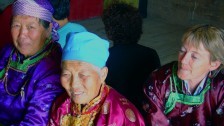
Caroline Humphrey (right) with women from local goat-herding families waiting for the distribution of auspicious 'mani' pills by the lamas at a Buddhist temple in Inner Mongolia. Credit: Caroline Humphrey
Tomorrow we launch a series of 12 articles by Cambridge researchers who tell us about the unfamiliar places where they've spent the night in the course of their work. Introducing the Extreme Sleepover series, distinguished anthropologist Professor Dame Caroline Humphrey reflects on how fieldwork not only enriches researchers work but also touches their hearts and minds. The extreme can be a purely physical test but, when it involves experiencing the lives of other people, the notion has to be seen as relative: what appears extreme to one person is normal for another." - —Professor Dame Caroline Humphrey - Each one of the dozen reports contributed by Cambridge researchers is fresh and vivid; they tell us in their own words what field research is really like. I have travelled extensively in the course of my work. Yet it was a revelation to me that such a wide range of scientific research involves being there , putting oneself on the line whatever the conditions in order to learn more about your subject. This kind of work cannot be done in labs or libraries. What makes these accounts so fascinating is that they show how diverse are the demands of fieldwork, stretching human capacities in quite different ways.
TO READ THIS ARTICLE, CREATE YOUR ACCOUNT
And extend your reading, free of charge and with no commitment.