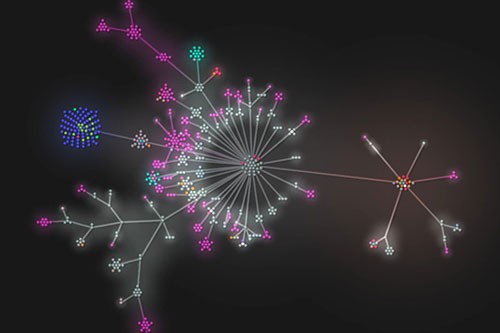
A graphical representation of LMFDB activity
A solution to the greatest unresolved problem in pure mathematics - Riemann's hypothesis - could be coming closer, thanks to a remarkable international collaboration involving mathematicians from the University of Bristol and University of Warwick, part-funded by a £2.24million grant from the Engineering and Physical Sciences Research Council (EPSRC). Seventy mathematicians from 12 countries are creating a massive online database - the L-functions and Modular Forms Database (LMFDB) - in an effort to document the last collection of elementary mathematical functions that we do not fully understand. If written on paper, the LMFDB would be an encyclopaedia of some 10,000 volumes with 500 pages each. Begun six years ago, it represents the collective work of over 70 collaborators in more than a dozen research areas, all of whom are building connections between their seemingly separate specialities. "Most of us are aware of these relationships in an abstract way, but it takes real work to actually figure out all the details," said Dr Andrew Booker of Bristol's School of Mathematics, a co-investigator on the EPSRC grant. Several important theoretical discoveries have already occurred as a result of the LMFDB project. These include important steps towards a major goal of twenty-first century mathematics: understanding Riemann's hypothesis.
TO READ THIS ARTICLE, CREATE YOUR ACCOUNT
And extend your reading, free of charge and with no commitment.