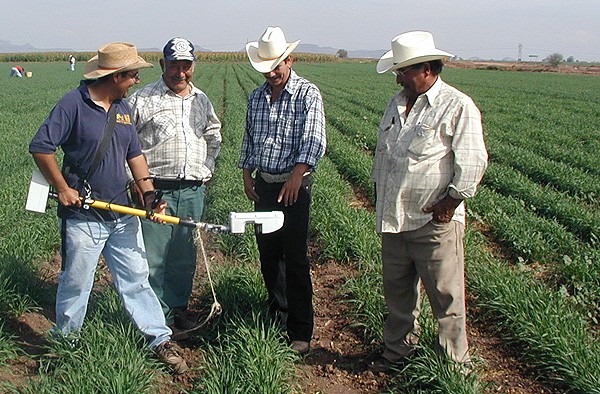
Farmers in Mexico’s Yaqui Valley use a nitrogen sensor to optimize fertilizer application, thus reducing costs and agricultural runoff.
To successfully introduce technologies to improve agricultural sustainability in developing countries, scientists must understand and engage not only the research experts but also the social and economic networks that local farmers rely on, Stanford researchers say. BY DONNA HESTERMAN New technologies can improve agricultural sustainability in developing countries, but only with the engagement of local farmers and the social and economic networks they depend on, say Stanford University researchers. Their findings are published in the May 23 online edition of the Proceedings of the National Academy of Sciences (PNAS) . "Most people tend to think that technology information flows to farmers through a direct pipeline from scientists, but that isn't true," said lead author Ellen McCullough, a former research fellow at Stanford's Program on Food Security and the Environment , now at the Bill and Melinda Gates Foundation. The study was co-authored by Pamela Matson , dean of the School of Earth Sciences and senior fellow at the Woods Institute for the Environment at Stanford. To better understand how farmers decide to adopt new technologies, the researchers interviewed growers, farm credit unions and agricultural experts in the Yaqui Valley in Sonora, Mexico - the birthplace of the "green revolution" in wheat and one of Mexico's most productive breadbaskets. Matson and other Stanford researchers have been working in the Yaqui Valley for nearly 20 years.
TO READ THIS ARTICLE, CREATE YOUR ACCOUNT
And extend your reading, free of charge and with no commitment.