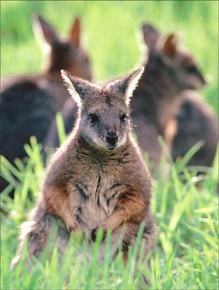
The Tammar Wallaby; manlier than man?
Researchers from The Australian National University have discovered that the male-specific Y-chromosome is shrinking - and it's happening at different rates across species. The research team discovered that a marsupial's Y-chromosome is genetically denser than the human Y-chromosome, meaning that animals like the tammar wallaby are bounds ahead on the 'manliness' scale. However, even though the Y-chromosome is shrinking, in this case size doesn't matter. The international study, led by Paul Waters from the ANU Research School of Biology, analysed DNA samples from tammar wallabies and found more genes on the male chromosome than expected. "There were lots of genes that we weren't expecting to find," said Waters. "These genes have been lost from the Y-chromosome in placental mammals like humans but, for some reason, they have been retained in marsupials. "This means there are different rates of gene loss on the Y-chromosome across species." The Y-chromosome is one of two sex chromosomes carried in males from most mammal species.
TO READ THIS ARTICLE, CREATE YOUR ACCOUNT
And extend your reading, free of charge and with no commitment.