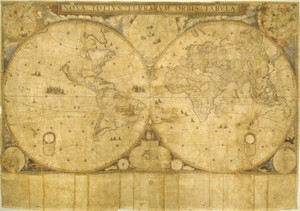
Joan Blaeu's world map "Nova Totius Terrarum Orbis Tabula," 1648. The Ransom Center's copy, one of only two known to exist and the only colored copy, survives complete with an accompanying text. Photo by Pete Smith.
AUSTIN, Texas — The Harry Ransom Center, a humanities research library and museum at The University of Texas at Austin, has introduced an online database for its entire Kraus map collection. The 36-map collection, acquired in 1969 by Harry Ransom from the New York antiquarian dealer Hans P. Kraus, features a wide range of individual maps of Europe and America, atlases, a rare set of large terrestrial and celestial globes (ca. 1688) produced by the Italian master Vincenzo Coronelli and a group of manuscript letters by Abraham Ortelius. "Visitors can see the remarkable foundations of modern cartography in this digital collection," said Richard Oram, the Ransom Center's associate director and Hobby Foundation Librarian. "From a medieval map that shows the world divided into three parts split by the Mediterranean Sea to an early portolan chart of the coast of Africa and a rare 1541 Mercator globe, it's all accessible from any computer desktop with an Internet connection." Because of size and conservation considerations-some of the maps are as large as 6 by 9 feet-some of these maps have only been seen by a handful of visitors. This digital collection makes it possible for a larger public to examine the collection via the Ransom Center's website. The maps are all zoom-able, and users can view detailed close-ups of images. Among the Kraus collection treasures are the maps, atlases and globes produced in the Low Countries during the 16th and 17th centuries by the accomplished cartographers Willem Blaeu (and sons), Gerard Mercator and Abraham Ortelius.
TO READ THIS ARTICLE, CREATE YOUR ACCOUNT
And extend your reading, free of charge and with no commitment.