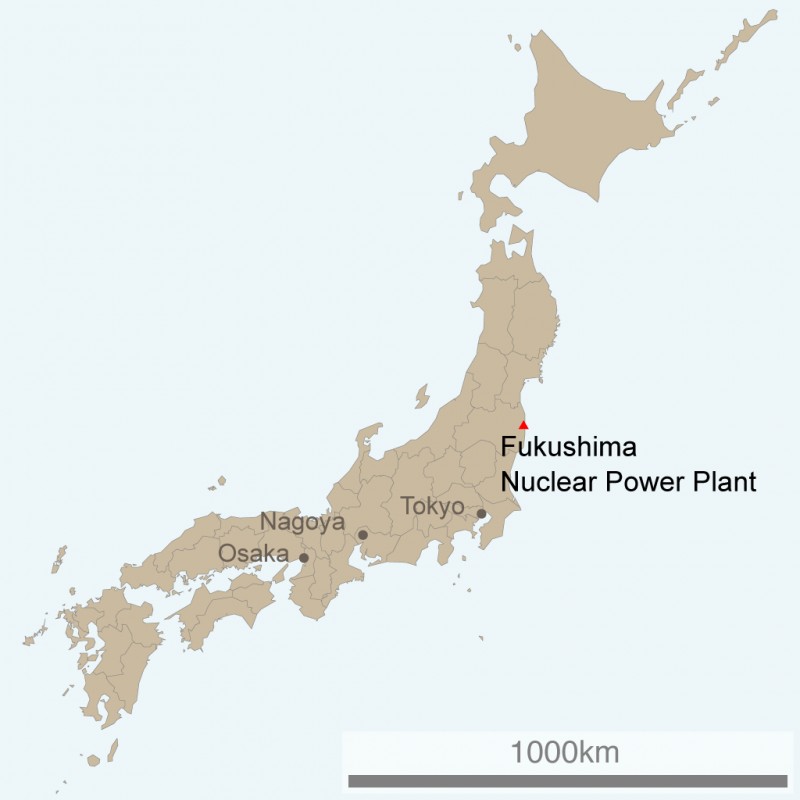
Location of Fukushima I Nuclear Power Plant, Japan. Image credit: Wikimedia Commons
ANN ARBOR, Mich.-A year after the crisis at Japan's Fukushima Daiichi nuclear power plant, scientists and engineers remain largely in the dark when it comes to fundamental knowledge about how nuclear fuels behave under extreme conditions, according to a University of Michigan nuclear waste expert and his colleagues. In a review article in this week's edition of the journal Science, U-M's Rodney Ewing and two colleagues call for an ambitious, long-term national research program to study how nuclear fuels behave under the extreme conditions present during core-melt events like those that occurred at Fukushima following the March 11, 2011, magnitude 9.0 earthquake and tsunami. Three of the plant's six boiling-water reactors suffered partial core-melt events that involved tremendously high temperatures and powerful radiation fields, as well as interaction between seawater and nuclear fuel. Many tons of seawater were used to cool the overheated reactors and nearby spent-fuel storage ponds, and direct discharge of contaminated seawater to the ocean and groundwater occurred through approximately April 8. "What I realized while watching all of this was how little we actually knew about what happens if you take hot seawater and pour it on nuclear fuel," said Ewing, a professor in the Department of Earth and Environmental Sciences, the Department of Nuclear Engineering and Radiological Sciences, and the Department of Materials Science and Engineering. Ewing is also a member of the U.S. Nuclear Waste Technical Review Board.
TO READ THIS ARTICLE, CREATE YOUR ACCOUNT
And extend your reading, free of charge and with no commitment.