Rachel Philipson
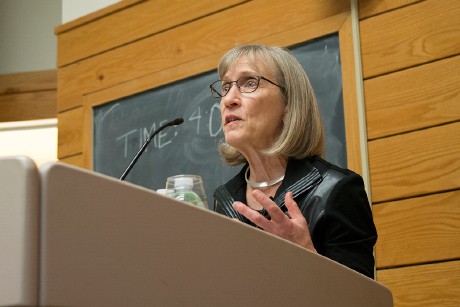
In the last few decades, the percentage of men versus women in the workforce has converged, but gender inequality in wages persists. Claudia Goldin '67 explained why, and what can be done to achieve equality, at a College of Arts and Sciences sesquicentennial lecture Oct. 24, "A Grand Gender Convergence: Its Last Chapter." Goldin explained that economists used to believe the difference in education, college majors and length of time out of the labor market explained the gender pay gap. But, she said, women's time out of the workforce has decreased and years of education by women has surpassed men. In many professions women are in the majority. What can be done to eliminate the persistent pay gap? The answer, said Goldin, the Henry Lee Professor of Economics at Harvard University and director of the Development of the American Economy program at the National Bureau of Economic Research, is to change the structure of the workplace to increase "linearity" in respect to earnings. (If someone works twice as many hours and earns twice as much, that's linear; if someone works twice as many hours and earns three times as much, that's nonlinear.
TO READ THIS ARTICLE, CREATE YOUR ACCOUNT
And extend your reading, free of charge and with no commitment.