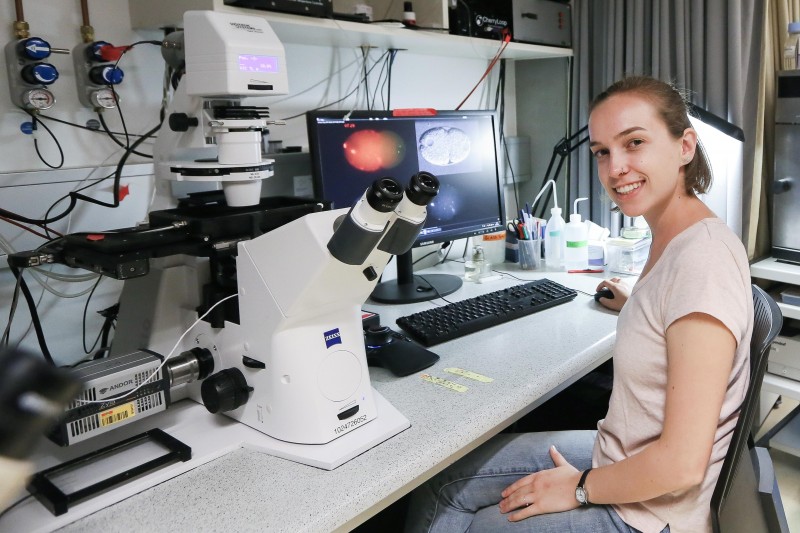
 Sarah Herrman in the lab
Summer Series: Sarah Herrman is visiting Pierre Gönczy's lab at EPFL from the University of California, Santa Cruz. Her project looks at how the cell's centrosomes help organize the polarity and function of the developing embryo. Centrosomes are cell organelles that are best known for their involvement in cell division. Each centrosome is made up of two small tubes arranged perpendicular to each other, called the centrioles. In turn, each centriole is made up of nine sets of microtubules. When cell division begins, two centrosomes form at each pole of the cell and begin to assemble a spindle of fibers that will eventually split the cell's genetic material (e.g. its chromosomes) in half, delivering a set to each of the two daughter cells.
TO READ THIS ARTICLE, CREATE YOUR ACCOUNT
And extend your reading, free of charge and with no commitment.
Your Benefits
- Access to all content
- Receive newsmails for news and jobs
- Post ads