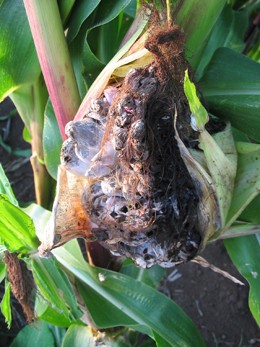
The U. maydis maize infection. Photo by Britta Winterberg.
A genome-level study of two closely-related infectious fungi, that can affect maize crops, is offering scientists new ways of understanding how to breed more disease-resistant crop plants. An international research team that includes Dr Britta Winterberg of the ANU Research School of Biology has been looking at the genes of two very similar pathogenic fungi. Both fungi - Ustilago maydis and Sporisorium reilianum - infect maize plants. However, they lead to very distinctive infection symptoms on their host plant. While U. maydis forms large tumors on leaves and flowers in which it develops millions of spores, an infection with S. reilianum is symptomless until the plant flowers. By looking at the diseases at a genetic level, the researchers have been able to identify differences betweens the genomes and manipulate the fungi to be both less, and more, virulent. 'Both fungi are so called biotrophic, meaning that they feed on living plant material. They secrete proteins into the host plant to escape the immune system of the plant and to manipulate the host,' said Dr Winterberg. 'During evolution the plants develop new 'weapons' against the fungi. This evolution leads to 'armament'; the plant develops new proteins to detect and kill the pathogen, and the fungus mutates to escape this recognition.' By comparing the fungi, the researchers were able to see where the differences were at a genetic level. 'Regions that are different ' or divergent - between the two fungi are probably under high evolutionary pressure, because they need to evolve to protect the fungus from the plant immune system. The identification of divergent gene clusters gives insight into the proteins that are essential for infection,?
TO READ THIS ARTICLE, CREATE YOUR ACCOUNT
And extend your reading, free of charge and with no commitment.