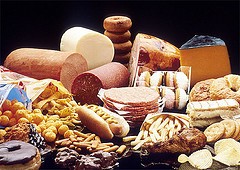
Credit: National Cancer Institute Foods with high fat content
UNIVERSITY PARK, Pa. A preference for fatty foods has a genetic basis, according to researchers, who discovered that people with certain forms of the CD36 gene may like high-fat foods more than those who have other forms of this gene. The results help explain why some people struggle when placed on a low-fat diet and may one day assist people in selecting diets that are easier for them to follow. The results also may help food developers create new low-fat foods that taste better. "Fat is universally palatable to humans," said Kathleen Keller, assistant professor of nutritional sciences, Penn State. "Yet we have demonstrated for the first time that people who have particular forms of the CD36 gene tend to like higher fat foods more and may be at greater risk for obesity compared to those who do not have this form of the gene. In animals, CD36 is a necessary gene for the ability to both detect and develop preferences for fat.
TO READ THIS ARTICLE, CREATE YOUR ACCOUNT
And extend your reading, free of charge and with no commitment.