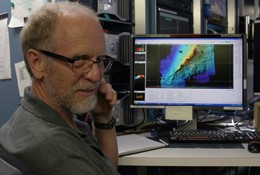
Richard Arculus is trying to understand what's been happening through time deep in the Earth beneath Fiji. Photo by Charles Tambiah.
Scientists will soon have a greater understanding of the dramatically spreading, rifting and faulting boundary of the Australian and Pacific tectonic plates, thanks to research from The Australian National University. Professor Richard Arculus from the Research School of Earth Sciences, part of the ANU College of Physical and Mathematical Sciences, led a research team of geologists on a three-week research voyage over May to June. In the waters between Fiji and the French territory of Futuna, Professor Arculus and his team have been investigating the widespread submarine volcanism and hydrothermal activity along this highly active part of the Australian-Pacific tectonic plate boundary. "The area has long been regarded as a geological anomaly. If you look at any map of the world's oceans that shows depths, Fiji and its basins to the east and west look really strange: anomalously shallow, with Fiji itself looking like the centre of a geological hurricane," Professor Arculus said. "What we found was the region to the north of Fiji is one that joins the colliding Pacific and Australian plates. These plates are respectively being driven beneath each other, the Pacific beneath Australia along the Tonga Trench, and Australia beneath the Pacific along the New Hebrides Trench.
TO READ THIS ARTICLE, CREATE YOUR ACCOUNT
And extend your reading, free of charge and with no commitment.