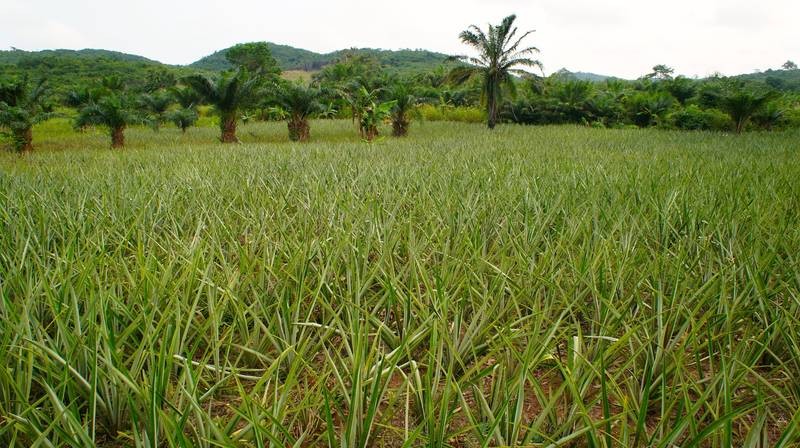
Establishing sustainable agriculture is the goal for pineapple cultivation in Ghana. This reduces the irreversible damage to the soil, increases its fertility and, in the end, also yields and income. (Photo: TUM/ D. Wüpper)
Research news - Simple technologies can be learned effectively through imitation, while complex methods require professional training. If Ghanaian pineapple farmers are to achieve higher yields through more sustainable agriculture, they will need to be trained in exactly these types of complex applications. This was the conclusion reached by a team from the Technical University of Munich (TUM) and the Kiel Institute for the World Economy (ifW), who provide evidence for this assertion in the form of a new study with recommendations. For two months, the agricultural economist Dr. David Wüpper from the Chair Group Agricultural Production and Resource Economics at TUM worked with around 400 Ghanaian pineapple farmers in a hot and humid tropical region south of the Ghanaian metropolis of Kumasi. He and Dr. Linda Kleemann from the ifW - with the support of several other interviewers and translators - examined the learning effects of training and imitation. A number of the farmers had already been interviewed several years ago. A Much-Too-Short Success Story.
TO READ THIS ARTICLE, CREATE YOUR ACCOUNT
And extend your reading, free of charge and with no commitment.