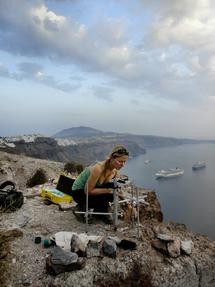
Michelle Parks makes GPS measurements on Santorini.
A new survey suggests that the chamber of molten rock beneath Santorini's volcano expanded 10-20 million cubic metres - up to 15 times the size of London's Olympic Stadium - between January 2011 and April 2012. The growth of this 'balloon' of magma has seen the surface of the island rise 8-14 centimetres during this period, a team led by Oxford University scientists has found. The results come from an expedition, funded by the UK's Natural Environment Research Council, which used satellite radar images and Global Positioning System receivers (GPS) that can detect movements of the Earth's surface of just a few millimetres. The findings are helping scientists to understand more about the inner workings of the volcano which had its last major explosive eruption 3,600 years ago, burying the islands of Santorini under metres of pumice. However, it still does not provide an answer to the biggest question of all: when will the volcano next erupt? A report of the research appears in this week's Nature Geoscience . In January 2011, a series of small earthquakes began beneath the islands of Santorini. Most were so small they could only be detected with sensitive seismometers but it was the first sign of activity beneath the volcano to be detected for 25 years.
TO READ THIS ARTICLE, CREATE YOUR ACCOUNT
And extend your reading, free of charge and with no commitment.