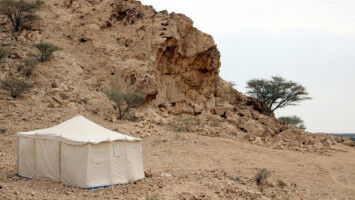
A Princeton-led team of geologists analyzed samples of inorganic and organic carbon from the hills of the Trezona Formation in South Australia to document one of the largest perturbations to the carbon cycle in all of Earth history. (Photo: Adam Maloof) Images for news media
For insight into what can happen when the Earth's carbon cycle is altered - a cause and consequence of climate change - scientists can look to an event that occurred some 720 million years ago. New data from a Princeton University-led team of geologists suggest that an episode called "snowball Earth," which may have covered the continents and oceans in a thick sheet of ice, produced a dramatic change in the carbon cycle. This change in the carbon cycle, in turn, may have triggered future ice ages. Pinpointing the causes and effects of the extreme shift in the way carbon moved through the oceans, the biosphere and the atmosphere - the magnitude of which has not been observed at any other time in Earth history - is important for understanding just how much Earth's climate can change and how the planet responds to such disturbances. Publishing their findings in the April 30 issue of the journal Science, the researchers also put forth a hypothesis to explain how changes to Earth's surface wrought by the glaciers of the Neoproterozoic Era could have created the anomaly in carbon cycling. "The Neoproterozoic Era was the time in Earth history when the amount of oxygen rose to levels that allowed for the evolution of animals, so understanding changes to the carbon cycle and the dynamics of the Earth surface at the time is an important pursuit," said Princeton graduate student Nicholas Swanson-Hysell , the first author on the paper. A Princeton-led team of geologists analyzed samples of inorganic and organic carbon from the hills of the Trezona Formation in South Australia to document one of the largest perturbations to the carbon cycle in all of Earth history.
TO READ THIS ARTICLE, CREATE YOUR ACCOUNT
And extend your reading, free of charge and with no commitment.