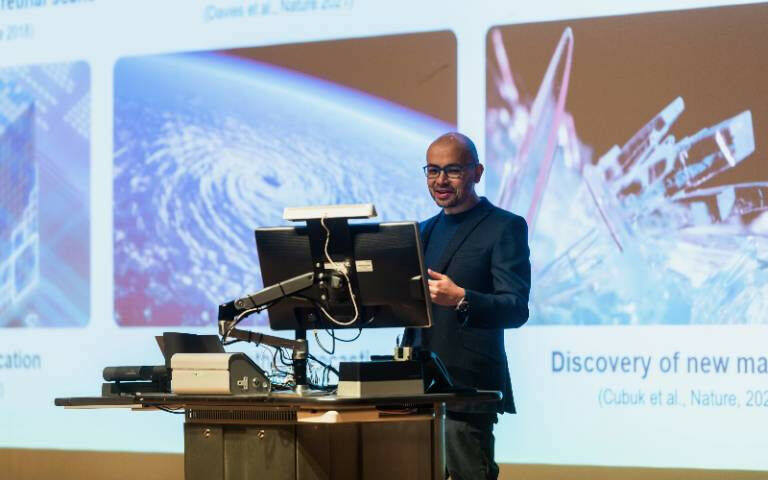
Demis Hassabis gives the UCL Prize Lecture - Credit: James Tye
Demis Hassabis gives the UCL Prize Lecture - Credit: James Tye The 2023 UCL Prize Lecture in Life and Medical Sciences has been delivered by UCL alumnus Demis Hassabis CBE, co-founder and CEO of Google DeepMind, one of the world's leading Artificial Intelligence research groups. Speaking on the topic of 'Using AI to Accelerate Scientific Discovery', the world-renowned researcher and entrepreneur revealed how his childhood passions for chess and computer games led him to develop a deeper interest in computer science and thought processes. Hassabis went on to complete a PhD in Cognitive Neuroscience under the supervision of Professor Eleanor Maguire at UCL in 2009, where he met future collaborator Dr Shane Legg (UCL Honorary Fellow 2016) at the Gatsby Computational Neuroscience Unit. They co-founded DeepMind the following year, and the company was acquired by Google in 2014. It has c'onsistently been at the forefront of AI development, producing landmark research breakthroughs such as AlphaGo (the first program to beat the world champion at the complex game of Go) and AlphaFold, heralded as a solution to the 50-year grand challenge of protein folding. In his sold-out lecture, which was attended by more than 900 people in person and nearly 500 online, Hassabis argued that - if built responsibly - AI could be used for the overwhelming benefit of humanity and highlighted some of the incredible scientific breakthroughs that it has so far assisted. He also discussed the possibilities of personalisation built on our "digital biology" in areas such as healthcare, the dangers of "deep fakes", and his hopes for the future of the field - including improving the planning, reasoning and memory of AI models.
TO READ THIS ARTICLE, CREATE YOUR ACCOUNT
And extend your reading, free of charge and with no commitment.