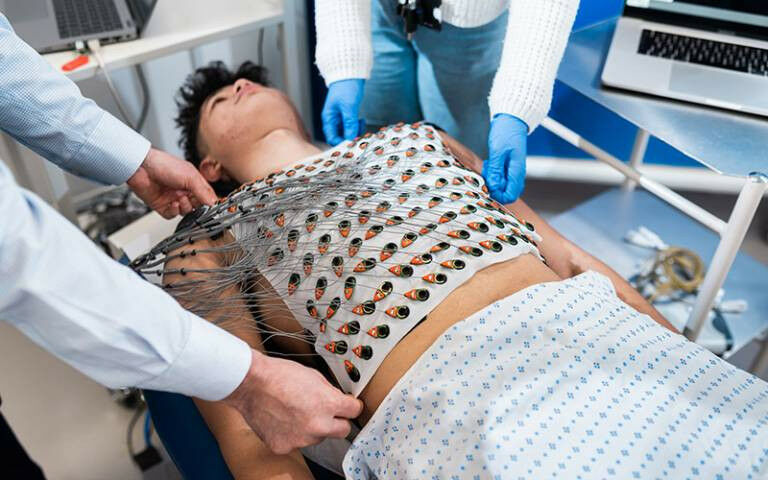
UCL medical student in the vest
UCL medical student in the vest A re-usable vest that can map the electrical activity of the heart in fine detail could potentially be used to better identify people at high risk of sudden cardiac death, suggests a new study led by UCL researchers. Electrical signals trigger our hearts to contract, regulating our heartbeat. Problems with these signals result in heart rhythm disorders, experienced by two million people in the UK, and can cause sudden death. Until now, detailed mapping of the heart's electrical activity was rare - requiring either a catheter to be inserted inside the heart cavity or carried out using single-use devices that were costly and time consuming to set up, and involve radiation. But an electrocardiographic imaging (ECGI) vest developed by UCL researchers, described in a new paper in the Journal of Cardiovascular Magnetic Resonance , holds potential to be used in standard care as it is re-usable and time-efficient, with only five minutes needed per patient. Electrical data from the vest's 256 sensors can be combined with detailed images of heart structures taken by MRI (magnetic resonance imaging) to generate 3D digital models of the heart and the waves of electrical activity flowing through it. Dr Gaby Captur (UCL Institute of Cardiovascular Science and the Royal Free Hospital, London), who developed the vest with funding from the British Heart Foundation (BHF), said: "We identified a problem in cardiology.
TO READ THIS ARTICLE, CREATE YOUR ACCOUNT
And extend your reading, free of charge and with no commitment.