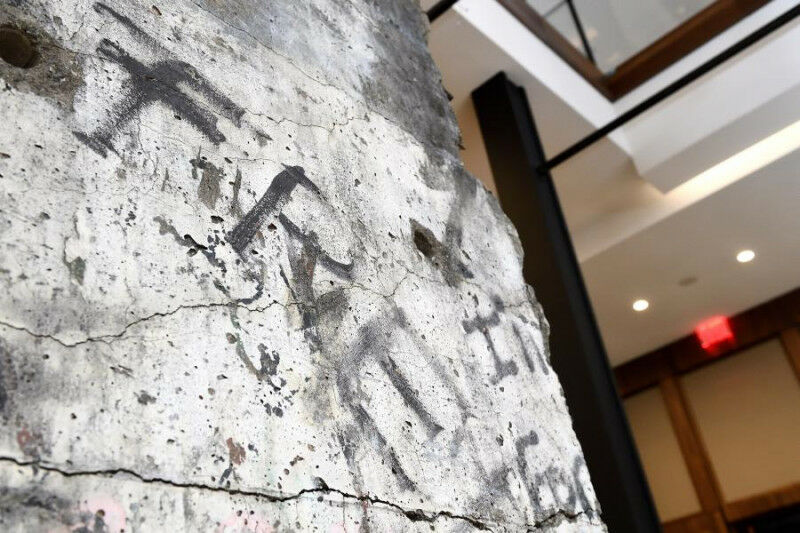
A fragment of the Berlin Wall in close up
Tracing the journey of Johns Hopkins' piece of the Berlin Wall from Germany to its new home at the Hopkins Bloomberg Center. A fragment of the Berlin Wall in close up - When the Berlin Wall fell in 1989 during a pro-democracy uprising, it signaled the dissolution of East Germany's communist regime, the reunification of Germany, and the end of the decades-old Cold War. In the following years, the remaining pieces of the wall have taken on new meaning; once a formidable symbol of the Iron Curtain, they now are exhibited across the globe as reminders of the power of protest and spirit of democracy. Today, a fragment of the wall stands at the Johns Hopkins University Bloomberg Center at 555 Pennsylvania Ave. in Washington, D.C. The wall fragment first arrived at the Johns Hopkins School of Advanced International Studies in Washington in 1997, when it was installed in the courtyard of SAIS' Nitze Building on Massachusetts Avenue. It was a gift from the Berlin Senate acknowledging the role SAIS and the American Institute for Contemporary German Studies-now the American-German Institute -played in fostering relations between the United States and postwar Germany. Standing at an imposing 11 feet, 10 inches tall and weighing nearly 7,000 pounds, the wall fragment's journey required years of planning and a German naval ship for transport.
TO READ THIS ARTICLE, CREATE YOUR ACCOUNT
And extend your reading, free of charge and with no commitment.