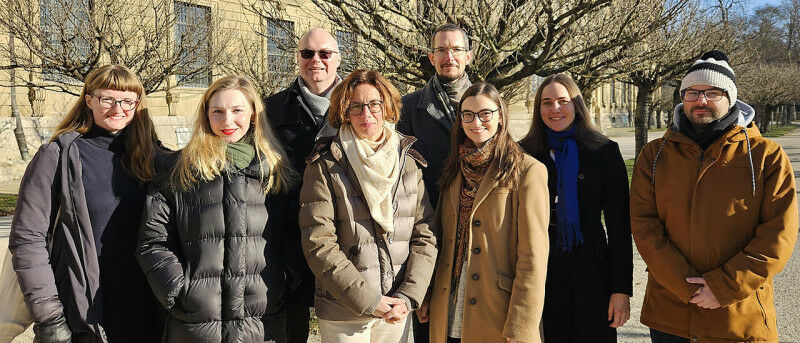
The project team, from left to right: Anna Kontriner, Maria Janosch, Rene Pfeilschifter, Barbara Schmitz, Jan R. Stenger, Isabel Virgolini, Sandra Erker and René Walter. (Image: Eva Fürst)
The project team, from left to right: Anna Kontriner, Maria Janosch, Rene Pfeilschifter, Barbara Schmitz, Jan R. Stenger, Isabel Virgolini, Sandra Erker and René Walter. (Image: Eva Fürst) - How did local people get organized in the ancient world? This is the subject of a new research project at the University of Würzburg involving Theology, Philology and History. Did the citizens of Rome know associations? Did inhabitants of Jerusalem set up grassroots movements? Did the regular patrons of an Athenian pub discuss the latest political decision-making? The question how neighborhood people formed groups in order to assert themselves and to pursue shared interests is difficult to answer two thousand years later. One of the reasons is that this topic has hardly been investigated by researchers so far. 1.4 million Euros from the DFG. In order to fill this gap, a new research project at the Julius-Maximilians-Universität Würzburg (JMU) is now focusing on these issues: "Locality and Society: Horizontal Binding Forces in Antiquity". The researchers involved are interested in self-governing groups in local governance constellations during a period of roughly 1,000 years.
TO READ THIS ARTICLE, CREATE YOUR ACCOUNT
And extend your reading, free of charge and with no commitment.