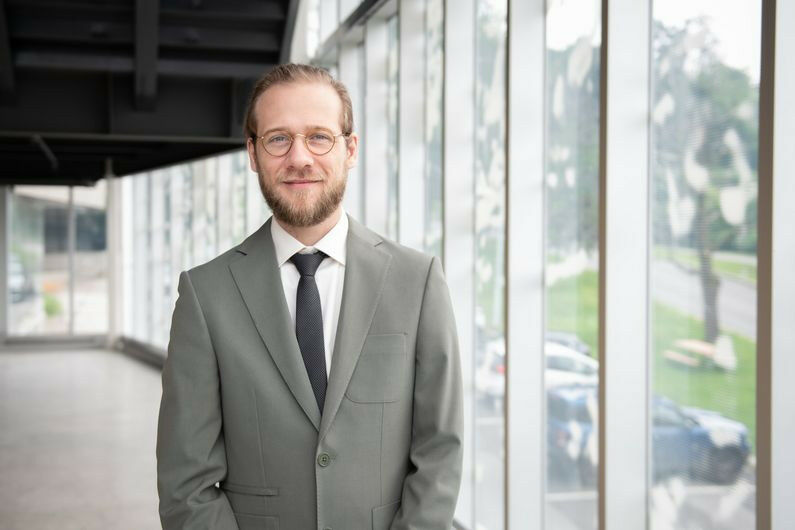
Ugo Gilbert Tremblay, assistant at the Faculty of Law Credit: Amélie Philibert
Ugo Gilbert Tremblay, assistant at the Faculty of Law Credit: Amélie Philibert New law professor Ugo Gilbert Tremblay brings his unique perspective integrating philosophy and neuroscience into the study of criminal law. What is freedom? Are we free or are our actions determined by a host of causes beyond our control? How much responsibility do we bear for our actions? At what point do we become responsible for our actions under the law? These are just some of the fundamental questions that Ugo Gilbert Tremblay has explored throughout his academic career and continues to explore after joining Université de Montréal-s Faculty of Law last March. -It started in CEGEP when I developed a passion for several different branches of knowledge,- Tremblay recalled. -Then it became clear to me that university was where I could nourish this passion. And now that I'm a professor,- he continued with a laugh, -I-ll never have to leave! No one does wrong voluntarily-. Tremblay's first degree was a bachelor's in philosophy at Université Laval, during which he became fascinated by the question of freedom, broadly speaking. -How much free will do we have after we factor in all the genetic and environmental causes underlying our behaviour?- he wondered. That, he realized, is the dilemma at the heart of the notion of freedom. Tremblay continued his studies in philosophy, this time at UdeM, completing his master's in 2014 on the notions of voluntary versus involuntary acts as set out in the writings of Plato. His goal?
TO READ THIS ARTICLE, CREATE YOUR ACCOUNT
And extend your reading, free of charge and with no commitment.