Emily
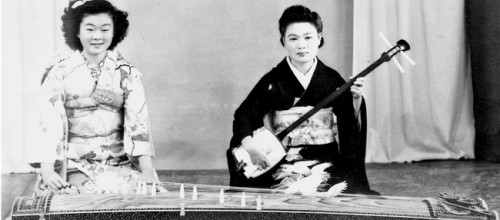
Tamura and her teacher, Kineya Katsuchiyo, at Amache
camp, in Colorado.
BERKELEY — At a century-old Buddhist temple in Los Angeles' Little Tokyo, seven elderly Japanese American artists appeared recently in a once-in-a-lifetime performance of music, dance, and theater. The event, titled "Hidden Legacy," honored individuals who taught traditional Japanese arts while imprisoned in far-flung WWII "relocation" camps. Mastery of any art or musical instrument requires patience, persistence, and time — as Shirley Muramoto Wong, who organized "Hidden Legacy," should know. The Berkeley staff member and alum is a master of the koto, a traditional Japanese stringed instrument. Her discovery of internment-camp artists, too, required not years but decades — as she tracked down now-elderly artists, coaxing out and recording their memories, to reveal their unsung role in history. Her interest was personal, as she had learned koto from her mother, who studied the instrument as a pre-teen at the Topaz, Utah and Tule Lake, Calif. camps.
TO READ THIS ARTICLE, CREATE YOUR ACCOUNT
And extend your reading, free of charge and with no commitment.