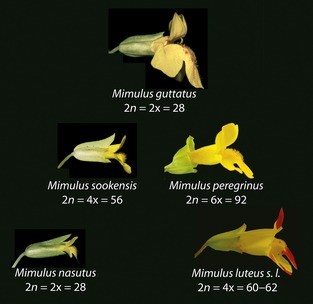
 Variations of M. guttatus, showing M. nasutus at the left bottom.
Predicting when and how species arise is now possible with a new theoretical model using genome-wide data, developed by SIB and University of Bern researcher Simon Aeschbacher and colleagues. The diversity of life on our planet is stunning. Recent estimates indicate that there are several millions of species, and this number does not even include some of the most diverse groups of organisms, such as bacteria or viruses. But how do species arise? Under what conditions will they persist? Can they arise without being spatially isolated? - "Answering these questions is challenging, as the process of speciation usually takes a long time compared to a researcher's lifespan," points out Simon Aeschbacher, an SIB scientist from the University of Bern. One way to solve the riddle is to observe, in vitro , speciation in organisms with very short generation times, such as viruses. Another way, which is not restricted to a single species or organism, is to mine their genomes in silico , using mathematical models. Simon notes that "In theory, genome sequences are windows to the past.
TO READ THIS ARTICLE, CREATE YOUR ACCOUNT
And extend your reading, free of charge and with no commitment.
Your Benefits
- Access to all content
- Receive newsmails for news and jobs
- Post ads