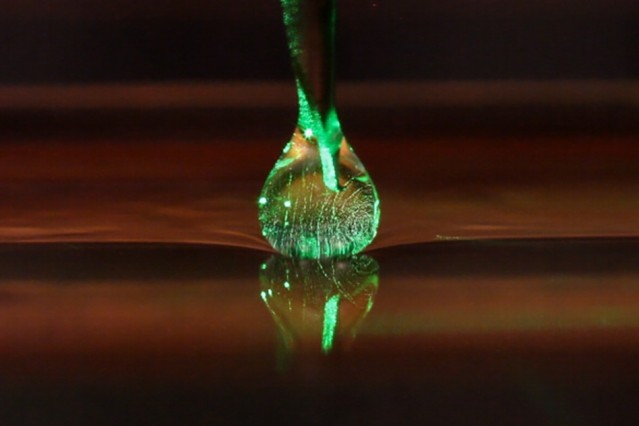
Visualization of vortices in a drop of silicone oil sitting on a warm bath. The temperature difference generates a recirculating flow that is visualized by shining a green laser light on fluorescent particles that are added as passive tracers within the drop.
A drop or two of cold cream in hot coffee can go a long way toward improving one's morning. But what if the two liquids didn't mix? MIT scientists have now explained why under certain conditions a droplet of liquid should not coalesce with the liquid surface below. If the droplet is very cold, and the bath sufficiently hot, then the droplet should "levitate" on the bath's surface, as a result of the flows induced by the temperature difference. The team's results, published today in the Journal of Fluid Mechanics , offer a detailed, mathematical understanding of drop coalescence, which can be observed in everday phenomena, from milk poured in coffee to raindrops skittering across puddles, and sprays created in surf zones. The results may help researchers understand how biological or chemical substances are spread by rain or other sprays in nature. They could also serve as a guide for droplet-based designs, such as in microfluidic chips, in which droplets carrying various reagents can be designed to mix only in certain locations in a chip, at certain temperatures. With this new understanding, researchers could also engineer droplets to act as mechanical ball bearings in zero-gravity environments.
TO READ THIS ARTICLE, CREATE YOUR ACCOUNT
And extend your reading, free of charge and with no commitment.