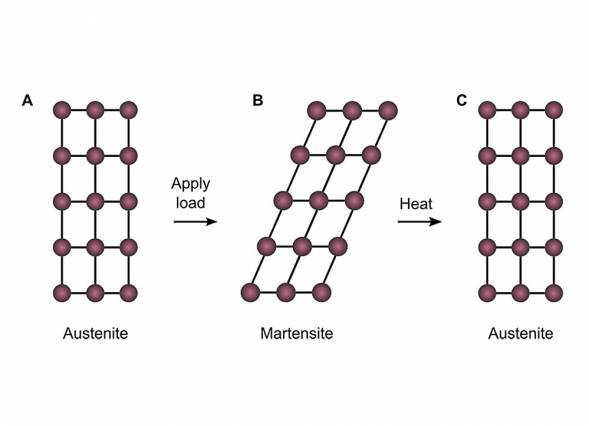
When subjected to a load, the molecular structure of the ceramic material studied by the MIT-Singapore team deforms rather than cracking. When heated, it then returns to its original shape. Though they have the same chemical composition, the two molecular configurations correspond to different natural minerals, called austenite and martensite.
Ceramics are not known for their flexibility: they tend to crack under stress. But researchers from MIT and Singapore have just found a way around that problem - for very tiny objects, at least. The team has developed a way of making minuscule ceramic objects that are not only flexible, but also have a "memory" for shape: When bent and then heated, they return to their original shapes. The surprising discovery is reported this week in the journal Science , in a paper by MIT graduate student Alan Lai, professor Christopher Schuh, and two collaborators in Singapore. Shape-memory materials, which can bend and then snap back to their original configurations in response to a temperature change, have been known since the 1950s, explains Schuh, the Danae and Vasilis Salapatas Professor of Metallurgy and head of MIT's Department of Materials Science and Engineering. "It's been known in metals, and some polymers," he says, "but not in ceramics." In principle, the molecular structure of ceramics should make shape memory possible, he says - but the materials' brittleness and propensity for cracking has been a hurdle. "The concept has been there, but it's never been realized," Schuh says.
TO READ THIS ARTICLE, CREATE YOUR ACCOUNT
And extend your reading, free of charge and with no commitment.