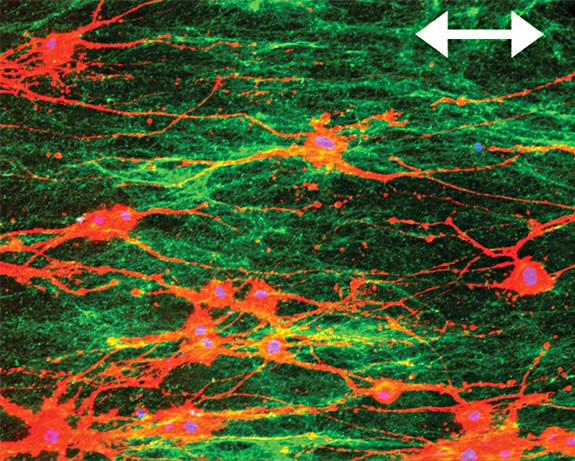
To treat severe nerve damage, of Molecular Biology Jean Schwarzbauer and of Chemistry Jeffrey Schwartz have designed a "neuron bridge" over which new neurons could grow, replacing damaged ones. They use a surface patterned with raised stripes, which Schwartz compares to lanes on a bridge, to encourage cells to align and grow in the same direction. The image shows neurons (red) growing on an aligned extracellular matrix (green). (Image courtesy of Jean Schwarzbauer, Department of Molecular Biology)
Inaugural Dean for Research Innovation Funds inspire bold directions. Posted March 4, 2014; 12:00 p.m. by Catherine Zandonella, Office of the Dean for Research A new initiative to encourage bold and creative research at Princeton University is poised to bear fruit: The first annual Dean for Research Innovation Funds have been awarded to a group of projects that push the boundaries of research in the natural sciences, encourage research partnerships with industry, and facilitate collaborations between investigators in the arts and the sciences or engineering. Created in fall 2013 to encourage promising and original research, the program supports projects that may be too risky for conventional funding sources, or involve uncommon collaborations, according to Dean for Research Pablo Debenedetti , the Class of 1950 Professor in Engineering and Applied Science and professor of chemical and biological engineering. "Through these new funds, Princeton University is enabling its researchers to pursue promising ideas that are at the early stages as well as collaborations that lead to new discoveries," Debenedetti said. • Bold research in the natural sciences awards: —"Neuron bridge" for nerve injury - Injuries to the spinal cord and other parts of the nervous system can be impossible or difficult to repair because new nerve cells have difficulty traversing the damaged or scarred region. Professor of Molecular Biology Jean Schwarzbauer and Professor of Chemistry Jeffrey Schwartz have been awarded $188,000 to develop an implantable "bridge" over which new neurons can grow.
TO READ THIS ARTICLE, CREATE YOUR ACCOUNT
And extend your reading, free of charge and with no commitment.