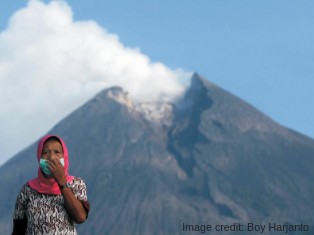
Respiratory protection during Merapi eruption Indonesia 2010 Credit: Boy Harjanto
Researching health hazards of volcanic emissions There are 1,500 active volcanoes worldwide andKīlauea volcano in Hawaii is one of the most active. In 2018, eruptions from Kīlauea intensified significantly. Dr Claire Horwell, in our Department of Earth Sciences, has been providing public information on the health impacts of eruptions, including the smog from Kilauea, known as "vog", in collaboration with the USGS Hawaiian Volcano Observatory. Here she explains her work. How do you assess the respiratory hazards of volcanic ash? During an eruption crisis, it can be very challenging to conduct medical surveillance to find out if the ash emissions are causing a health impact. Using geochemical and toxicological analyses, however, we can rapidly determine the potential respiratory hazard of the ash. For example, we can assess the particle size distribution of the ash so that we can quickly say if the ash has an inhalable component - if it is too large to inhale then it can't have a respiratory impact! We can use sophisticated instrumentation such as laser diffractometers or, if these are not available, even basic sieves can give an indication of the hazard. Another critical technique is X-ray diffraction which allows us to determine the presence and quantity of crystalline silica in the ash, which has the potential to be devastatingly pathogenic, as seen in thousands of miners who have developed silicosis and lung cancer. We're not yet sure if the silica in ash will cause such diseases, but we need to be aware if it is in the ash so that civil protection managers can take precautionary steps to protect communities. How do you gather evidence of the local experience of living near a volcano?
TO READ THIS ARTICLE, CREATE YOUR ACCOUNT
And extend your reading, free of charge and with no commitment.