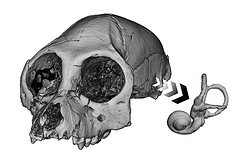
Three-dimensional reconstruction of the cranium and semicircular canals
from the fossil anthropoid primate Aegyptopithecus zeuxis. Specimen
courtesy of the Egyptian Geological Museum and Division of Fossil
Primates, Duke Lemur Center.
UNIVERSITY PARK, Pa. CT scans of fossilized primate skulls or skull fragments from both the Old and New Worlds may shed light on how these extinct animals moved, especially for those species without any known remains, according to an international team of researchers. The researchers looked at the bony labyrinth in fossil remains and compared them to CT scans previously obtained from living primate species. The bony labyrinth of the inner ear is made up of the cochlea - the major organ of hearing - the vestibule and the three semicircular canals which sense head motion and provide input to synchronize movement with visual stimuli. "Almost in every case where there is a fossilized skull, the semicircular canals are present and well preserved," said Timothy Ryan, assistant professor of anthropology, geosciences and information sciences and technology, Penn State. "They are embedded in a very dense part of the skull and so are protected." Normally, researchers assess the locomotor behaviors of extinct animals, including primates, by examining limb bones. However, frequently the only fossilized remains found are from the head.
TO READ THIS ARTICLE, CREATE YOUR ACCOUNT
And extend your reading, free of charge and with no commitment.