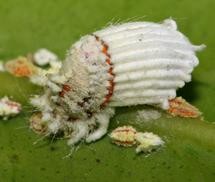
Icerya purchasi, an insect where males are replaced by ’parasitic’ fathers. Photo: P Hollinger
Evolution may lead to males disappearing as they are replaced by 'parasitic fathers' who infect their daughters at birth in order to mate with them. The finding comes from Oxford University scientists studying how hermaphrodite insects, such as the scale insect Icerya purchasi , in which the same individual produces both sperm and eggs and mates with itself, might have evolved. A report of the research appears in the August issue of The American Naturalist . 'It turns out that females in these hermaphrodite insects are not really fertilizing their eggs themselves, but instead are having this done by a parasitic tissue that infects them at birth,' said Laura Ross of Oxford University's Department of Zoology, an author of the report. 'It seems that this infectious tissue derives from left-over sperm from their father, who has found a sneaky way of having more children by mating with his daughters.' 'Of course, females might not be happy about this,' said Andy Gardner of Oxford University's Department of Zoology, also an author of the report. 'So, we developed a mathematical model to find out when the female and the parasite will come into conflict, and when they will collaborate over this weird reproductive tactic, to understand how it evolves.' The researchers found that, once the infection becomes endemic, females are more inclined to mate with their parasitic fathers in this way, because mating with a close relative ensures that they pass on more copies of their genes to future generations.
TO READ THIS ARTICLE, CREATE YOUR ACCOUNT
And extend your reading, free of charge and with no commitment.